This is the second post in a series on gut dysbiosis, covering SIBO.
As an Amazon Associate, I earn from qualifying purchases.
Who is Betsy Leighton?
I’m a writer, blogger, and healer dedicated to helping individuals reconnect with their innate peace and wholeness by healing nervous system dysregulation. My personal experience with chronic illness called Mast Cell Activation Syndrome (MCAS) shapes my work, and my content offers tools to empower those with chronic illness to improve their well-being and take charge of their health.
I created the Sacred Self-Healing Method and am a trained and certified Safe and Sound Protocol provider, an author, blogger, and A Course in Miracles Teacher. I hold a Master of Divinity in Spiritual Counseling and am a trained spiritual mentor, with certificates in sound healing, aromatherapy, nutrition, and Sacred Deathcare. I offer a self-study certificate program in the Sacred Self-Healing Method, provide spiritual counseling and coaching, courses, and supported subscriptions for the Safe and Sound Protocol.
What is MCAS?
Mast Cell Activation Syndrome (MCAS) is a chronic condition that affects all organ systems. It can cause severe, disabling symptoms every day, including potentially fatal anaphylaxis.
The common triggers for MCAS are infections, toxic exposures including mold exposure and EMFs, trauma, concussions, and stress.
MCAS often occurs with other chronic conditions like Ehlers-Danlos Syndrome (EDS) and Postural Orthostatic Tachycardia Syndrome (POTS). Managing MCAS is challenging because many healthcare providers are unaware of it, and diagnostic tests can be unreliable. Treatments include antihistamines and mast cell stabilizers in the form of medications and supplements, along with avoiding triggers. Check out this post on managing MCAS.
What is gut dysbiosis?
Gut dysbiosis is an imbalance in the community of microorganisms that live in the digestive tract, where harmful or inflammatory microbes become too dominant and beneficial microbes decline. In a healthy gut, diverse bacteria help digest food, support the immune system, maintain the gut lining, and produce essential compounds like vitamins and short-chain fatty acids. When this balance is disrupted—by factors such as antibiotics, chronic stress, infections, poor diet, or toxin exposure—the gut becomes more prone to inflammation, reduced digestive efficiency, and increased permeability (“leaky gut”). This imbalance can contribute to digestive symptoms, immune dysregulation, and a variety of chronic health conditions.
Revisiting concussions
I’ve written about how I’ve experienced several concussions in my life, which was a key factor in developing MCAS and SIBO. Here’s why:
A concussion is a traumatic event. An injury to the brain is interpreted as an attack on the body, activating the sympathetic “fight or flight” response and affecting vagus nerve activity. Being in a state of stress slows digestive function, decreases enzyme production, slows gut motility, and restricts blood flow to the digestive organs.
This disruption of digestive function increases intestinal permeability, also known as leaky gut. My concussions disrupted my gut motility, or the rate at which food travels through the GI tract, and I began developing stomach aches before I entered puberty. Subsequently, multiple concussions set me up for severe disruption of the gut microbiome.
Concussions are a key determinant of MCAS, and, as I’ve mentioned previously, healing the nervous system is a key part of healing MCAS.
Gut dysbiosis and SIBO
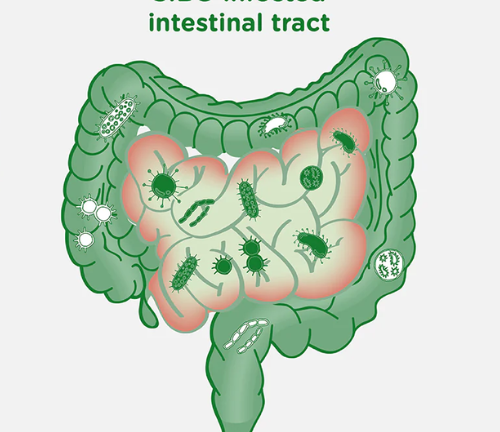
Like MCAS, SIBO is a complicated condition. Even though SIBO is a chronic bacterial overgrowth that can be treated with antibiotics, antibiotics can also cause SIBO. Antibiotic exposure kills both harmful and helpful bacteria, disrupting the microbiome’s balance. When “good” bacteria are killed, harmful bacteria can proliferate and overgrow, increasing the risk of developing SIBO. Additionally, chronic exposure to antibiotics can lead to drug-resistant bacteria, making SIBO and other infections more challenging to treat
I grew up in a generation before doctors realized that bacteria could become resistant to antibiotics. So, whenever I got a sore throat as a child, my mom would rush me into the clinic for a penicillin injection, whether or not I actually had strep throat.
I also had bad acne starting at age 11, and I began taking antibiotics like Tetracycline for my acne in my early teens. I continued taking them on and off for almost 10 years. By my late teens, my gut motility had markedly slowed, and I began to experience difficulty with constipation.
Stress
Stress also interferes with many aspects of digestion, including gut motility. When we are under stress, our body produces less stomach acid, leading to reduced bile secretion and enzyme production, both of which can contribute to SIBO. Additionally, stress can weaken the immune system, allowing harmful bacteria to overgrow or leading to an infection that may require antibiotics, further increasing the risk of developing SIBO.
When I entered my young-adult years, my stress level ramped up with college papers to write, exams to take, and worries about the future. And by the time I finished college, I had developed anxiety. So, I believe that the combination of multiple concussions, antibiotic over-usage, and stress was a significant contributing factor to my developing SIBO. And then caregiving stress in my parenting years caused my stress to skyrocket and for my mast cells to go haywire.
Infections
In my junior year of college, I contracted Lyme Disease, which is also implicated in SIBO. SIBO is likely the most common gastrointestinal disorder associated with Lyme disease and other tickborne infections, and it is estimated that 60-70% of people with Lyme disease have SIBO.
My Lyme Disease went untreated for two decades until I finally saw a functional provider who understood tick-borne illnesses and was adept at treating them.
Finally, in my case, autoimmunity was yet another possible factor in the development of SIBO. In addition to Lyme Disease, I developed a host of other chronic infections over the two decades my Lyme Disease went untreated, including Ehrlichia, Epstein-Barr Virus, Bartonella, Babesia, herpes zoster virus, candida overgrowth, intestinal parasites, and Mycoplasma pneumonia. These untreated infections led to celiac disease-type symptoms, thyroid issues, arthritis, abnormal liver enzyme levels, chronic pain, and mast cell activation syndrome.
SIBO diagnosis
It turns out that SIBO is significantly underdiagnosed, despite it being a chief cause of irritable bowel syndrome (IBS), which affects roughly 11% of people worldwide.
The best way to determine whether you have SIBO and which bacterial overgrowth you have is to do a breath test. But part of the problem is that most doctors only know about the hydrogen breath test. Three gases produced by bacterial overgrowth are hydrogen, methane, and hydrogen sulfide. If you only test for hydrogen, you may miss the other two major contributors to SIBO.
My daughter, who also had SIBO, was seen at a prominent gastroenterology clinic, and they tested her for the presence of hydrogen. Because her hydrogen levels were low, they did not diagnose SIBO. But when she saw a functional provider who not only looked at all three of the gases in her breath testing, but also examined the relationship between the two that were over-proliferating, she received a positive SIBO diagnosis.
I did the breath test with the same functional provider, and my levels were off the charts! Finally, I understood the decades of GI discomfort I had experienced. After having SIBO for so long, it had become my “normal,” and I was astonished to have validation for all the SIBO symptoms I had experienced since childhood.
After researching MCAS and finally receiving a SIBO diagnosis, I began to understand the connection between the two conditions. I learned that patients with SIBO typically experience issues like diarrhea, constipation, gas, bloating, nausea, and malabsorption. Since mast cells are abundant in the intestines, when they are over-activated, they can signal for more mast cells to proliferate there. So, SIBO can be a significant trigger and driver of MCAS.
I also learned that MCAS can trigger SIBO. MCAS can cause SIBO by altering the GI immune system or motility via local release of mast cell mediators.
Toxic mold exposure
Yet another trigger for SIBO is toxic mold exposure, which is one of the major causes of MCAS. Mold toxicity disrupts the gut’s bacterial balance. If you have toxic mold exposure, your body tries to detoxify mold by dumping it into the gut. Thus, if you are trying to heal MCAS or SIBO, you won’t get any traction because mold toxins are continuously damaging your gut.
In fact, fungal overgrowth in the gut can cause a condition called SIFO (small intestinal fungal overgrowth). So, if you have experienced toxic mold exposure and you have distressing gut symptoms, the first place to address is mold. As I mentioned earlier in my discussion about mold, you do that by eliminating the source of mold exposure and ridding your body of it.
SIBO treatment
Treatment for SIBO depends on which gases are being produced, the levels of gas being produced in your GI tract, your symptoms, and your other diagnoses.
In my case, I had both hydrogen and methane gases being produced by bacterial overgrowth in my gut. The level of gases measured in my breath test indicated that the “bad” bacteria had colonized my entire GI tract, likely including the esophagus.
My treatment began with a one-week switch to the Specific Carbohydrate Diet. After that, I started a one-month herbal protocol, followed by one month of Rifaximin, an antibiotic typically prescribed for SIBO, among other things. Along with the antibiotics, I took several probiotics, including Saccharomyces Bulardi, and a broad-spectrum spore-based probiotic. I also took butyrate, a short-chain fatty acid that supports gut motility.
Antibiotic treatment alone for SIBO only has around a 30% success rate, and unfortunately, I soon experienced a recurrence of the symptoms of harmful bacterial overgrowth, and it felt like I was back to the drawing board.
Red light therapy heals the gut
Use Red Light Therapy — Red light therapy can be helpful for SIBO because it supports cellular healing and reduces inflammation in a gentle, non-triggering way. The wavelengths used in red and near-infrared light help stabilize mitochondria, improve energy production, and calm overactive immune responses—all of which can reduce the baseline reactivity that drives mast cell symptoms and SIBO flares. Red light also enhances microcirculation and tissue repair, which may ease pain, skin issues, and gut irritation common in MCAS. Because it acts through cellular and nervous system regulation rather than chemical ingredients, many people with sensitivities find it a soothing, well-tolerated, supportive therapy.
Butyrate
Butyrate helps heal concussions, SIBO, and sulfur cycle dysfunction. The butyrate brand I like is Tributyrin-X. Many types of butyric acid on the market don’t reach the colon, where it is needed, because it’s absorbed earlier in the gut. Tributyrin-X is specially formulated so that it is not absorbed until it reaches the colon. In addition to healing and sealing the colon’s walls, Tributyrin-X is also helpful for a host of other issues.
Low-dose naltrexone
Naltrexone is a drug that was developed to help people get off opioid drugs. Therapeutic dosages for naltrexone are around 50 mg or more, and are administered several times a day. In contrast, Low Dose Naltrexone (LDN) is a tiny dose of Naltrexone, often between 0.1 and 14 mg, and it is usually used once per day. Low Dose Naltrexone, has been shown to:
- Support healthy weight management.
- Heal leaky gut & tight junction support
- Regulate gut speed (motility)
- Promote microbiome diversity
- Help healthy mucosal layers
- Support proper immune system activity
- Support healthy mast cells and histamine levels
Factors in healing gut biosis
I’ve written a four-part series on the factors at work in healing gut dysbiosis, including:
Check out those linked posts for more information:
Related blog posts
This post covers symptom logging as a way to determine food sensitivities.
This post explains gut dysbiosis.
This post discusses how to figure out what to eat when you have MCAS or another chronic illness.
This post explains how meal planning helps with MCAS.
This post covers dairy sensitivity.
This post covers Food sensitivities.
The bucket theory
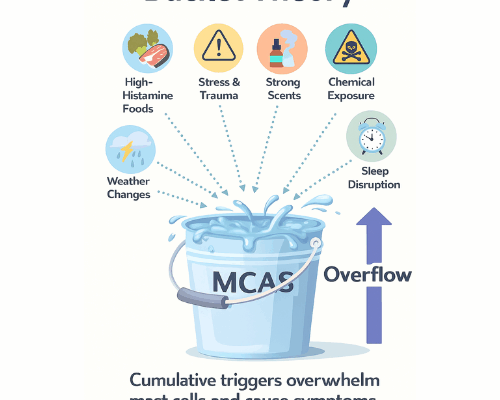
The bucket theory simplifies understanding symptom reactions with MCAS. Imagine your body as an empty bucket you don’t want to overflow. Reactions to various stimuli fill the histamine bucket at different rates, forming the total histamine level (how full your bucket is). More histamine means more symptoms. By managing triggers, reducing exposures, and taking medications and supplements, you can control your bucket’s level.
Know your typical symptom progression
Understanding your symptom progression during a flare is key to developing your rescue plan. This post discusses how to recognize symptom progression so you can be prepared to address them.
Get my free ebook, symptom log, and meal plan!
Want a tool to easily track your symptoms?
Check out these circadian health tools!
I’m an affiliate with Bon Charge, a company that makes tools for circadian health, and you can receive 15% off your order with my coupon code BETSYL.
Bon Charge offers tools such as yellow– and red-tone blue-blocking glasses, red light therapy devices, PEMF mats, infrared saunas, and EMF-blocking products.
Sign up for the SSP!
I’ve found the Safe and Sound Protocol (SSP) to be the most helpful bottom-up healing strategy if your nervous system has been overloaded with toxic exposures, including mold or non-native EMFs, chronic infections, concussions, stress, or trauma. The SSP is a passive listening therapy that helps heal nervous system dysregulation. Many people with MCAS and other chronic conditions have nervous system dysregulation stemming from infections, toxic exposures, concussions, and trauma. The SSP is an easy-to-use app that lets you listen to specially filtered music for 30 minutes each day as part of a 5-hour cycle. Studies show the SSP has a profound effect on mental health and chronic conditions. Here’s a short podcast describing the Safe and Sound Protocol.
You can sign up for the SSP here!
Heal your mind!
While the SSP is a bottom-up, somatic therapy for healing the nervous system, the Sacred Self-Healing Method I offer is a top-down nervous system-healing modality that focuses on cognition, attention, perception, and emotion, using the mind’s higher functions. The SSP and the Sacred Self-Healing Method complement each other and together produce lasting results. Here’s a short podcast on my self-healing practice.
I provide one-on-one in-person and remote chronic illness and caregiver coaching, as well as Sacred Self-Healing Sessions based on the Sacred Self-Healing Method, a proven, novel co-creative healing modality detailed in my Books.
Order my books!
Here’s a short podcast highlighting my five books.
My latest book, Living In The Light: Healing with Forgiveness, Sound, and Light, is all about the tools that have been most helpful for me to heal: forgiveness, sound, through nervous system retraining using the Safe and Sound Protocol, and light, through entraining my circadian rhythm with the energy of the sun. Living In The Light is available here!
Rocks and Roots chronicles my solo backpacking journey on the Superior Hiking Trail and my efforts to overcome nervous system dysregulation, gut dysbiosis, and Mast Cell Activation Syndrome symptoms to complete the 328-mile hike successfully.
The Sacred Self-Healing Method ebook is available here and in most ebook retailers!
The Sacred Self-Healing Workbook is available for purchase here!
Betsy’s first book, Sacred Self-Healing: Finding Peace Through Forgiveness, is available here
Companion Recordings
The companion audio recordings of chants, guided meditations, and sound healing demonstrations that accompany the Sacred Self-Healing Method are available for free on my YouTube channel here
What do you think?
I’d love to have your reply below!
Disclaimer
The preceding material does not constitute medical advice. This information is for information purposes only and is not intended to be a substitute for professional medical advice, diagnosis, cure, or treatment.