This post offers caregiver survival tips when you have a chronic illness yourself. If your loved one needs your help, you jump in without a second thought! But taking time to evaluate what your loved one needs, who else is available to help, and what they can afford, can ensure that you are not doing everything yourself. If you are the only caregiver available, you need to be extra careful to watch your stress levels when you yourself are chronically ill.
As an Amazon Associate, I earn from qualifying purchases.
Table of Contents
Caregiver survival tips start with acknowledging the prevalence of caregiving
Caregiving is widespread and hidden. There are an estimated 43 million informal caregivers in the United States today. As the population ages, you may find yourself thrust into the role of caregiver without giving it conscious consideration. But if you are chronically ill, the cost to your health can be considerable!
Caregiver survival tips orient you
Caregiving is disorienting. Roles change when you become a caregiver, and relationships, expectations, and responsibilities can be overturned overnight. Inevitably, caregivers experience disorientation because most of us don’t plan to take on caregiving roles. You might not have the skills to discuss these changes and advocate while you are in the throes of this disorientation. Seeking support from a therapist or counselor can help keep things in perspective.
Caregiver survival tips for recentering
Caregiving is stressful. The stress of caring for another person goes beyond everyday work-life stress, as you are often on call 24/7. If your loved one’s health concern is new or fluctuates, you may feel off-balance, not knowing when you can leave them or how to attend to your own needs. It can be overwhelming to suddenly have to take into account everything about a loved one’s life: their diet, medications, appointments, and well-being. All of this contributes to putting your own needs on the back burner. The long-term stress of caregiving can cause unaddressed issues in your own health to flare up, making you unable to care for either your loved one or yourself.
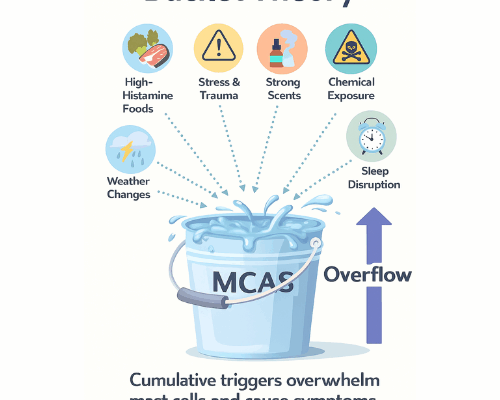
The bucket theory
The bucket theory simplifies understanding symptom reactions with MCAS. Imagine your body as an empty bucket you don’t want to overflow. Reactions to various stimuli fill the histamine bucket at different rates, forming the total histamine level (how full your bucket is). More histamine means more symptoms. By managing triggers, reducing exposures, and taking medications and supplements, you can control your bucket’s level.
Know your typical symptom progression
Understanding your symptom progression during a flare is key to developing your rescue plan. This post discusses how to recognize symptom progression so you can be prepared to address them.
Get my free ebook, symptom log, and meal plan!
Want a tool to easily track your symptoms?
Fatigue and trauma of caregiving
As well, the fatigue and exhaustion that caregivers experience are off the charts, because all of our systems are taxed at once. (See my post on trauma and Vagus Nerve Health)
Trauma therapist Eileen Devine, LCSW, writes about how many caregivers experience multiple layers of exhaustion. She lists four layers:
Caregiver Burnout – when you become demoralized, disillusioned, cynical, and exhausted on all levels. (see my Guide to Self-Care)
Relational Stress – when it feels like your relationship with your environment (or other people in your environment) exceeds your resources and endangers your well-being.
Trauma – when your caregiving experience includes trauma on a daily or regular basis from stressful caregiving interactions, medical procedures, medical trauma, or being the target of aggression. (see my Guide to Clearing Trauma for Vagus Nerve Health)
Compassion Fatigue – when you gradually lose compassion over time, resulting from an ongoing relationship with a needy individual.
Each of these conditions, taken separately, merits professional help. Together, they are utterly overwhelming. To survive as a caregiver, Devine recommends the following tactics:
Caregiver survival tips
Recognize the struggle of caregiving
Recognize your experience for all that it is. Honor your feelings and get professional support when needed. The fatigue, trauma, and stress all need to be named and processed in a healthy way to be able to continue to function.
Choose support wisely
Choose support wisely and avoid toxic people and relationships that don’t feed you. Don’t hang out with people who drain your already tapped-out energy in your downtime. Seek supportive relationships with people who get what you are going through. It can be more challenging to find them, but associating with other caregivers through support groups or online chats can give you the validation you need.
Prioritize yourself
Prioritize yourself and delegate anything and everything that you can. This is for your survival. Figure out how those around you can help, and ask for it. You can’t do everything, and your survival depends on taking care of yourself. Easier said than done. But focus on self-care ideas that give you the most bang for your buck. Take naps, even micro-naps!
Don’t make assumptions.
Don’t assume that those around you, even your partner or closest friends, understand the full impact of your trauma. Find ways to let them know how you are doing and ask them for help. Making assumptions can create even greater feelings of isolation.
Fill your bucket of j.oy
If something brings you joy or is restorative, it should be considered an absolute necessity. Plan for whatever you can, like a massage, a walk with a friend, or ordering food. Then have a bag packed for the instant you have a brief unplanned break, with whatever you need to recharge so that you can take advantage of it. Think about what really feeds you and have it ready to go, like a book, a chocolate bar, or funny videos ready to watch on your phone.
Listen to your body
Caregiving is exhausting work. Most caregivers suffer physical ailments as a result of constantly being “on call.” If you have aches or pains, see a chiropractor, get a massage, try to get adequate sleep, get some form of exercise, eat nourishing foods, and drink plenty of water. Being a martyr won’t help you or anyone else. If you have a serious health problem, please attend to it.
Check out these circadian health tools!
I’m an affiliate with Bon Charge, a company that makes tools for circadian health, and you can receive 15% off your order with my coupon code BETSYL.
Bon Charge offers tools such as yellow– and red-tone blue-blocking glasses, red light therapy devices, PEMF mats, infrared saunas, and EMF-blocking products.
Sign up for the SSP!
I’ve found the Safe and Sound Protocol (SSP) to be the most helpful bottom-up healing strategy if your nervous system has been overloaded with toxic exposures, including mold or non-native EMFs, chronic infections, concussions, stress, or trauma. The SSP is a passive listening therapy that helps heal nervous system dysregulation. Many people with MCAS and other chronic conditions have nervous system dysregulation stemming from infections, toxic exposures, concussions, and trauma. The SSP is an easy-to-use app that lets you listen to specially filtered music for 30 minutes each day as part of a 5-hour cycle. Studies show the SSP has a profound effect on mental health and chronic conditions. Here’s a short podcast describing the Safe and Sound Protocol.
You can sign up for the SSP here!
Heal your mind!
While the SSP is a bottom-up, somatic therapy for healing the nervous system, the Sacred Self-Healing Method I offer is a top-down nervous system-healing modality that focuses on cognition, attention, perception, and emotion, using the mind’s higher functions. The SSP and the Sacred Self-Healing Method complement each other and together produce lasting results. Here’s a short podcast on my self-healing practice.
I provide one-on-one in-person and remote chronic illness and caregiver coaching, as well as Sacred Self-Healing Sessions based on the Sacred Self-Healing Method, a proven, novel co-creative healing modality detailed in my Books.
Order my books!
Here’s a short podcast highlighting my five books.
My latest book, Living In The Light: Healing with Forgiveness, Sound, and Light, is all about the tools that have been most helpful for me to heal: forgiveness, sound, through nervous system retraining using the Safe and Sound Protocol, and light, through entraining my circadian rhythm with the energy of the sun. Living In The Light is available here!
Rocks and Roots chronicles my solo backpacking journey on the Superior Hiking Trail and my efforts to overcome nervous system dysregulation, gut dysbiosis, and Mast Cell Activation Syndrome symptoms to complete the 328-mile hike successfully.
The Sacred Self-Healing Method ebook is available here and in most ebook retailers!
The Sacred Self-Healing Workbook is available for purchase here!
Betsy’s first book, Sacred Self-Healing: Finding Peace Through Forgiveness, is available here
Companion Recordings
The companion audio recordings of chants, guided meditations, and sound healing demonstrations that accompany the Sacred Self-Healing Method are available for free on my YouTube channel here
What do you think?
I’d love to have your reply below!
Disclaimer
The preceding material does not constitute medical advice. This information is for information purposes only and is not intended to be a substitute for professional medical advice, diagnosis, cure, or treatment.