


This post discusses factors in determining the best diet for MCAS. Each patient will have different tolerated foods, unique triggers, and individual susceptibility to particular mast cell mediators. So the answer to this question will be unique to each person.
Along my healing journey, I’ve tried intermittent fasting, the GAPS Protocol, low histamine diet, gluten-free, dairy-free, nightshade-free, grain-free, soy-free, sugar-free, Primal diet, Paleo diet, low histamine diet, low oxalate diet, low salicylate, low FODMAP, Specific Carbohydrate Diet (SCD), anti-inflammatory diet, Supergut diet*, and Keto diet. This post covers these options
As an Amazon Associate, I earn from qualifying purchases.
Table of Contents
Who is Betsy Leighton?
I’m a writer, blogger, and healer dedicated to helping individuals reconnect with their innate peace and wholeness by healing nervous system dysregulation. My personal experience with chronic illness called Mast Cell Activation Syndrome (MCAS) shapes my work, and my content offers tools to empower those with chronic illness to improve their well-being and take charge of their health.
I created the Sacred Self-Healing Method and am a trained and certified Safe and Sound Protocol provider, an author, blogger, and A Course in Miracles Teacher. I hold a Master of Divinity in Spiritual Counseling and am a trained spiritual mentor, with certificates in sound healing, aromatherapy, nutrition, and Sacred Deathcare. I offer a self-study certificate program in the Sacred Self-Healing Method, provide spiritual counseling and coaching, courses, and supported subscriptions for the Safe and Sound Protocol.
What is MCAS?
Mast Cell Activation Syndrome (MCAS) is a chronic condition that affects all organ systems. It can cause severe, disabling symptoms every day, including potentially fatal anaphylaxis.
The common triggers for MCAS are infections, toxic exposures including mold exposure and EMFs, trauma, concussions, and stress.
MCAS often occurs with other chronic conditions like Ehlers-Danlos Syndrome (EDS) and Postural Orthostatic Tachycardia Syndrome (POTS). Managing MCAS is challenging because many healthcare providers are unaware of it, and diagnostic tests can be unreliable. Treatments include antihistamines and mast cell stabilizers in the form of medications and supplements, along with avoiding triggers. Check out this post on managing MCAS.
Mast cell mediators
When you think of MCAS, you likely think of histamine, because it is probably the most well-known mast cell mediator. But many other mast cell mediators can activate mast cells besides histamine, including leukotrienes, cytokines, chemokines, and neutral proteases (chymase and tryptase). – source
The following graphic describes the symptoms associated with each type of mast cell mediator.
This post addresses mast cell mediators. The remainder of this post is focused primarily on the mediator histamine.
Reducing histamine
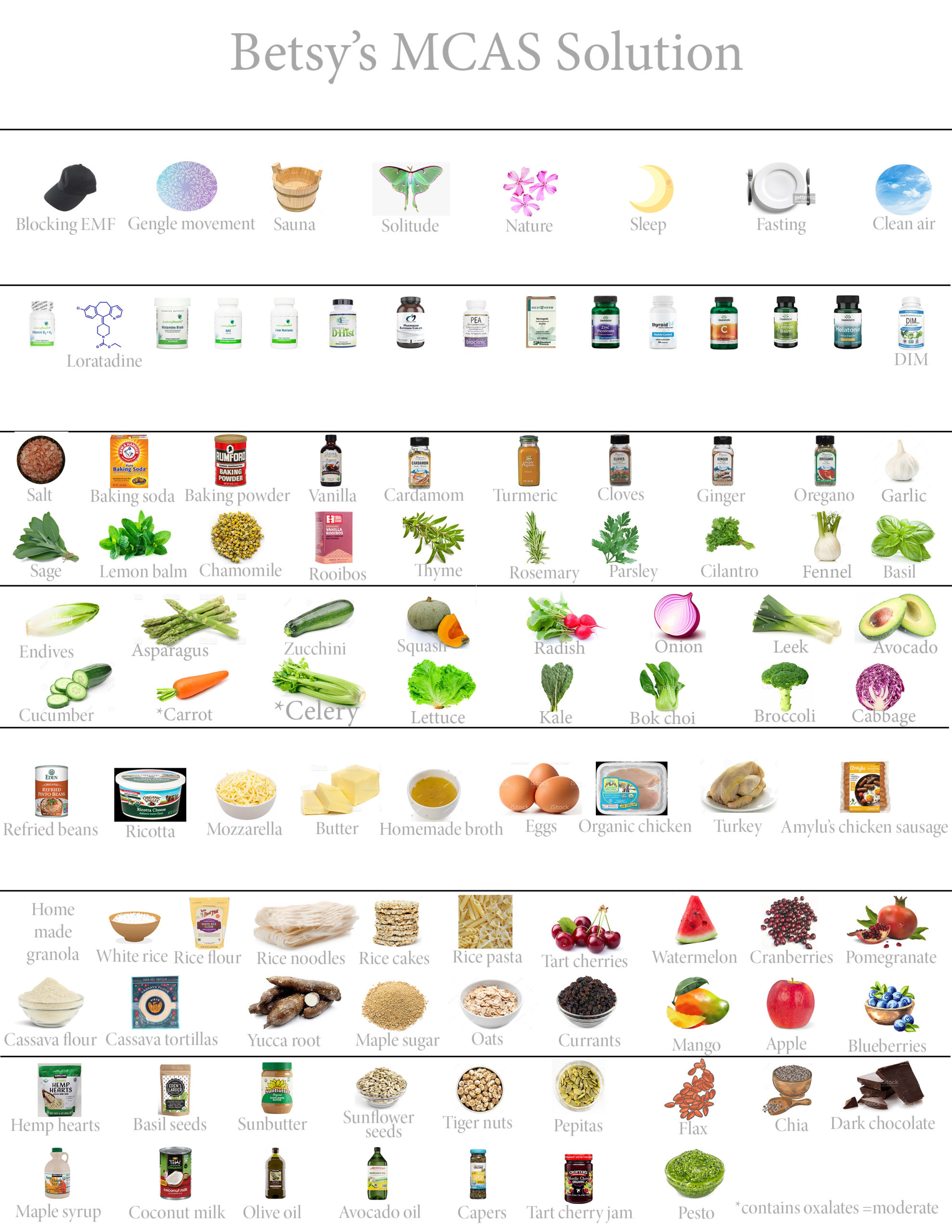
One major part of an MCAS diet is reducing histamine. That can mean eating foods that are generally lower in histamine, eating foods that actually reduce histamine, taking medications and supplements that control histamine in the body, and controlling the histamine your body creates.
This post discusses how to figure out what foods you tolerate.
This post lists generally tolerated lower-histamine foods.
This post provides information on anti-histamine foods.
Reducing inflammation
Another important part of an MCAS diet is reducing inflammation. Inflammation causes mast cells to gather in areas of the body where they perceive a threat. So, by reducing overall inflammation, you can reduce mast cell activation throughout your body.
The biggest inflammatory foods are gluten, dairy, and refined sugar, so most low-histamine food lists recommend eliminating one or more of those three. Gluten is my biggest trigger for inflammation, so I have been gluten-free for decades.
Refined sugars are a significant source of inflammation in the Western diet. This post discusses alternative sweeteners for MCAS.
Dairy products are another significant source of inflammation, and this post uncovers the issues with dairy and MCAS.
Fasting
Besides eliminating food sources of inflammation, fasting in the morning can also help to reduce overall inflammation and pain. Giving your gut a rest between periods of digesting food, or intermittent fasting, has been shown to reduce inflammation, improve immune function, and help with blood sugar issues:
Fasting periods have been shown in research to reduce blood pressure, improve circulating lipid and glucose levels, and limit inflammation by attenuating proinflammatory cytokines and immune cells. Furthermore, studies in both animals and humans suggest that fasting enhances metabolic efficiency, alters fuel selection, and reduces oxidative stress.
In addition, fasting has been shown to reduce mast cell degranulation and histamine release. So, you can reap multiple benefits from fasting: reduced inflammation, better blood sugar regulation, and less histamine release.
Fasting also helps you maintain a healthy weight, improves gut health and immune function, enhances brain health, and helps in the treatment of insulin resistance.
Of course, you should ease into intermittent fasting under the care of a doctor or functional provider. There is a lot of good advice for beginning fasters online. Still, you will want to avoid packaged foods marketed as “fasting-mimicking diet” because they are typically highly processed and likely to trigger mast cell activation and/or histamine issues.
However, fasting can also cause mast cell reactions due to:
1. Blood Sugar Fluctuations
• Fasting can lead to drops in blood glucose levels, which the body perceives as a stressor.
• Low blood sugar can trigger the release of stress hormones like cortisol and adrenaline, which are known to activate mast cells and promote histamine release.
• For people with MCAS, this may result in symptoms like flushing, itching, or gastrointestinal distress.
2. Stress Response Activation
• Prolonged fasting activates the hypothalamic-pituitary-adrenal (HPA) axis, leading to the release of corticotropin-releasing hormone (CRH).
• CRH directly stimulates mast cells, increasing histamine and inflammatory cytokine release, which can exacerbate mast cell-related symptoms.
3. Histamine Buildup
• During fasting, the body’s ability to metabolize and break down histamine may be impaired due to lower enzymatic activity (e.g., reduced levels of diamine oxidase (DAO), an enzyme responsible for histamine breakdown).
• This can lead to histamine accumulation, resulting in symptoms like headaches, rashes, or gastrointestinal issues.
4. Prolonged Fasting as a Trigger
• For some individuals, prolonged fasting can cause physical stress and inflammation, which may worsen mast cell instability.
• Fasting for too long may also increase gut acidity, irritating the stomach lining and activating mast cells in the process.
The Keto diet
Combining fasting with the Keto diet is one way to reduce overall inflammation and maintain a healthy weight, though it is a rigorous protocol, and not for everyone. I have struggled myself to maintain, especially the Keto portion of this combination. You will see that many of my recipes are compatible with the keto diet, but I readily acknowledge that it doesn’t suit everyone. When I am experiencing extra stress in my life, like when I am treating infections, I stop the Keto diet and focus on eating a lower histamine diet.
So what is a Keto diet? A Keto diet is high in fat and low in carbohydrates. When you follow a Keto diet, you rely on fat for your fuel, not sugars or carbohydrates (or glycogen stores). By consuming a diet high in fat, you are more likely to get into a metabolic state called Ketosis and burn fat as your fuel, making it easier to avoid carbohydrates. But why would you want to avoid carbs, you ask? Carbohydrates often cause inflammation, especially sugars and grains. Foods higher in fat don’t cause inflammation, and the Keto diet can help reduce inflammation.
What I mean by “Keto diet” in the mast cell and histamine intolerance context is not what you will likely find online. Many of the so-called Keto diet foods on the market are packaged and processed, and may be high in histamine or trigger histamine release. Many of the foods commonly prescribed on a Keto diet include fermented foods, aged cheeses, cured meats like bacon, nuts, dried fruits, vegetables from the nightshade family (tomatoes, eggplant, peppers, potatoes), and avocados. All of these foods might be healthy for the typical person on a Keto diet, but for those with MCAS or histamine intolerance, they could be deadly.
The Keto diet did not work for me, and I discuss why in this post.
Before you jump into a Keto diet or fasting, it is a good idea to consult your healthcare practitioner. A Keto diet itself can be a stressor on your digestive system. Any time you make a drastic change to your diet, you may feel worse. So, if you are interested in shifting to a high-fat diet, get guidance from your doctor, ease into it, go slow, and listen to your body.
Low FODMAP Diet
The best mast cell activation syndrome diet is the one that helps relieve your unique symptoms. A low FODMAP diet can be helpful if you are experiencing gut dysbiosis.
FODMAPs (fermentable oligosaccharides, disaccharides, monosaccharides, and polyols) are fermentable carbohydrates. Many people eat these carbohydrates without any issues. Still, some people are unable to break them down, or they ferment too much, often due to gut bacterial dysbiosis, such as SIBO (small intestinal bacterial overgrowth). Gut dysbiosis can cause stomach pain, bloating, and diarrhea. High-FODMAP diets can increase urinary histamine, whereas low-FODMAP diets can reduce it.
For more about low FODMAP diets, see this post.
GAPS diet
This post discusses the GAPS diet.
Specific Carbohydrate Diet
This post discusses the SCD for MCAS.
Oxalates
Oxalic acid is an organic compound found in many plants, including leafy greens, vegetables, fruits, cocoa, nuts, and seeds.
In plants, it’s usually bound to minerals, forming oxalate. The terms “oxalic acid” and “oxalate” are used interchangeably in nutrition science.
Your body can produce oxalate on its own or obtain it from food. Vitamin C can also be converted into oxalate when it’s metabolized.
Once consumed, oxalate can bind to minerals to form compounds, including calcium oxalate and iron oxalate. This mostly occurs in the colon, but can also take place in the kidneys and other parts of the urinary tract.
In most people, these compounds are then eliminated in the stool or urine.
However, in sensitive individuals, high oxalate diets have been linked to an increased risk of kidney stones and other health problems.
I discuss oxalates in this post, this post, and this post.
Salicylates
Salicylates are natural chemicals made by plants. They are found in fruits and vegetables and help protect plants against disease and insects.
Salicylate extracts have been used medicinally for thousands of years. Salicylic acid, more commonly known as aspirin, relieves pain and inflammation and lowers fevers. However, salicylates can also cause health problems for people who take them. Learn about what salicylate does in the body and when you should avoid it.
I tried a low salicylate diet, but found it was not causing my MCAS issues.
Why You Should Avoid Salicylates
For many, salicylates provide the same protective effects in the body as they do for the plants that produce them. High-salicylate diets generally confer lower risks of cancer, heart disease, and diabetes.
Medically, salicylate derivatives such as white willow bark, methyl salicylate, and salicylic acid provide anti-inflammatory and pain-relieving benefits. Aspirin is often used to manage heart disease and has contributed to lowering heart disease death rates.
However, for others, dietary salicylates can lead to health problems. Such issues include insensitivities, allergies, and swelling of different organs.
I discuss salicylates in this post and this post.
Other ways to support a lower histamine diet
This post discusses helpful apps that can help you follow a special diet.
This post covers my favorite 10 cooking tools for a lower-histamine diet.
This post provides survival tips for eating a lower histamine diet away from home.
The bucket theory
The bucket theory simplifies understanding symptom reactions with MCAS. Imagine your body as an empty bucket you don’t want to overflow. Reactions to various stimuli fill the histamine bucket at different rates, forming the total histamine level (how full your bucket is). More histamine means more symptoms. By managing triggers, reducing exposures, and taking medications and supplements, you can control your bucket’s level.
Know your typical symptom progression
Understanding your symptom progression during a flare is key to developing your rescue plan. This post discusses how to recognize symptom progression so you can be prepared to address them.
Get my free ebook, symptom log, and meal plan!
Want a tool to easily track your symptoms?
Check out these circadian health tools!
I’m an affiliate with Bon Charge, a company that makes tools for circadian health, and you can receive 15% off your order with my coupon code BETSYL.
Bon Charge offers tools such as yellow– and red-tone blue-blocking glasses, red light therapy devices, PEMF mats, infrared saunas, and EMF-blocking products.
Sign up for the SSP!
I’ve found the Safe and Sound Protocol (SSP) to be the most helpful bottom-up healing strategy if your nervous system has been overloaded with toxic exposures, including mold or non-native EMFs, chronic infections, concussions, stress, or trauma. The SSP is a passive listening therapy that helps heal nervous system dysregulation. Many people with MCAS and other chronic conditions have nervous system dysregulation stemming from infections, toxic exposures, concussions, and trauma. The SSP is an easy-to-use app that lets you listen to specially filtered music for 30 minutes each day as part of a 5-hour cycle. Studies show the SSP has a profound effect on mental health and chronic conditions. Here’s a short podcast describing the Safe and Sound Protocol.
You can sign up for the SSP here!
Heal your mind!
While the SSP is a bottom-up, somatic therapy for healing the nervous system, the Sacred Self-Healing Method I offer is a top-down nervous system-healing modality that focuses on cognition, attention, perception, and emotion, using the mind’s higher functions. The SSP and the Sacred Self-Healing Method complement each other and together produce lasting results. Here’s a short podcast on my self-healing practice.
I provide one-on-one in-person and remote chronic illness and caregiver coaching, as well as Sacred Self-Healing Sessions based on the Sacred Self-Healing Method, a proven, novel co-creative healing modality detailed in my Books.
Order my books!
Here’s a short podcast highlighting my five books.
My latest book, Living In The Light: Healing with Forgiveness, Sound, and Light, is all about the tools that have been most helpful for me to heal: forgiveness, sound, through nervous system retraining using the Safe and Sound Protocol, and light, through entraining my circadian rhythm with the energy of the sun. Living In The Light is available here!
Rocks and Roots chronicles my solo backpacking journey on the Superior Hiking Trail and my efforts to overcome nervous system dysregulation, gut dysbiosis, and Mast Cell Activation Syndrome symptoms to complete the 328-mile hike successfully.
The Sacred Self-Healing Method ebook is available here and in most ebook retailers!
The Sacred Self-Healing Workbook is available for purchase here!
Betsy’s first book, Sacred Self-Healing: Finding Peace Through Forgiveness, is available here
Companion Recordings
The companion audio recordings of chants, guided meditations, and sound healing demonstrations that accompany the Sacred Self-Healing Method are available for free on my YouTube channel here
What do you think?
I’d love to have your reply below!
Disclaimer
The preceding material does not constitute medical advice. This information is for information purposes only and is not intended to be a substitute for professional medical advice, diagnosis, cure, or treatment.