


This post provides tips and tricks for surviving with MCAS away from home.
As an Amazon Associate, I earn from qualifying purchases.
Table of Contents
Who is Betsy Leighton?
I’m a writer, blogger, and healer dedicated to helping individuals reconnect with their innate peace and wholeness by healing nervous system dysregulation. My personal experience with chronic illness called Mast Cell Activation Syndrome (MCAS) shapes my work, and my content offers tools to empower those with chronic illness to improve their well-being and take charge of their health.
I created the Sacred Self-Healing Method and am a trained and certified Safe and Sound Protocol provider, an author, blogger, and A Course in Miracles Teacher. I hold a Master of Divinity in Spiritual Counseling and am a trained spiritual mentor, with certificates in sound healing, aromatherapy, nutrition, and Sacred Deathcare. I offer a self-study certificate program in the Sacred Self-Healing Method, provide spiritual counseling and coaching, courses, and supported subscriptions for the Safe and Sound Protocol.
What is MCAS?
Mast Cell Activation Syndrome (MCAS) is a chronic condition that affects all organ systems. It can cause severe, disabling symptoms every day, including potentially fatal anaphylaxis.
The common triggers for MCAS are infections, toxic exposures including mold exposure and EMFs, trauma, concussions, and stress.
MCAS often occurs with other chronic conditions like Ehlers-Danlos Syndrome (EDS) and Postural Orthostatic Tachycardia Syndrome (POTS). Managing MCAS is challenging because many healthcare providers are unaware of it, and diagnostic tests can be unreliable. Treatments include antihistamines and mast cell stabilizers in the form of medications and supplements, along with avoiding triggers. Check out this post on managing MCAS.
Surviving with MCAS away from home
The following material does not constitute medical advice. This information is for information purposes only and is not intended as a substitute for professional medical advice, diagnosis, cure, or treatment. Always seek advice from your medical doctor.
If you have Mast Cell Activation Syndrome (MCAS), you will likely experience challenges when you are away from home. In this post, I share tips and tricks I have discovered for successfully traveling, eating, and staying comfortable while away from home.
Come prepared
If you are like me, when you are away on a trip, you might think you can get away with carrying less rescue gear, eating more adventurously, and adopting a more cavalier attitude toward potential issues. To an extent, yes, it’s great to let down your guard a bit while you are on a trip. Take deeper breaths. Explore untraveled paths. Try not to overthink things. And get out of your head.
But to make trips safe and doable, there are some caveats to that plan for people with Mast Cell Activation Syndrome (MCAS) or other chronic illnesses. You still need to follow your tolerated food diet. You still need to take your medications and daily maintenance treatments. Pack your nebulizer (there are portable car versions). And bring the supplies that will keep you safe and comfortable.
Know your food triggers
For eating on trips, you may want to share the list of possible food triggers with family members or hosts where you will be staying or who you will be sharing meals with. That way, they can plan, ask you questions, or you can let them know you will bring what you need to eat safely, so they need not worry about it. Here is a list of common MCAS food triggers. Your triggers will be unique to you, so this should be considered just a starting point.
- Unfiltered Tap Water (chlorinated, heavy metals)
- Caffeine & Alcohol (DAO inhibitors)
- Charred/ Burnt Food (especially animal meat/skin)
- Leftovers, Aged foods, Fermented foods, Pickles, Preserves, Olives
- Vinegar (especially rice vinegar)
- Soy Sauce and Soy Products
- Shellfish (Crabs, Prawns, Shrimp, Lobster, Crayfish, Squid, Calamari, Octopus, Mussels, Clams, Oysters, Scallops)
- Bananas
- Citrus Fruit
- Avocado
- Eggs
- All Legumes
- Spicy Food
- Sugar Substitutes
- Salicylates (stevia, etc)
- Oxalates, Salicylates, Lectins
- Additives (colorants, flavors, gums, Sulphites, Preservatives such as Sodium Benzoate)
- Glyco-phosphates in non-organic vegetables
- Gluten
- Nightshade Family vegetables (Tomato, Eggplant, Potatoes, Goji Berries, Peppers)
- Strawberries, Raspberries, Pineapple, Pears, Kiwi Fruit, Papaya
- Nuts (especially peanuts, walnuts, and cashews)
The bucket theory
The bucket theory simplifies understanding symptom reactions with MCAS. Imagine your body as an empty bucket you don’t want to overflow. Reactions to various stimuli fill the histamine bucket at different rates, forming the total histamine level (how full your bucket is). More histamine means more symptoms. By managing triggers, reducing exposures, and taking medications and supplements, you can control your bucket’s level.
Know your typical symptom progression
Understanding your symptom progression during a flare is key to developing your rescue plan. This post discusses how to recognize symptom progression so you can be prepared to address them.
Get my free ebook, symptom log, and meal plan!
Want a tool to easily track your symptoms?
Plan for downtime
Traveling is tiring. You get out of your routine, stay in unfamiliar surroundings, and see people who are new and different. All of this can be stressful on some level and raise your bucket level. One way to address this is to plan an itinerary with intentional breaks. You may want to plan a recovery day for after you arrive at your destination.
If you will be visiting with people one day, make the next day a rest day. Or make part of the day a rest time. Take naps, or at least lie down. If you are sightseeing and will be walking more than usual, take breaks and slow down if necessary. You may need to plan so that every other day is simply a day to recuperate from visiting and sightseeing. If you use a wheelchair regularly or tire easily, and know it would be helpful to have one available, call ahead and ask the airline to provide one at the airport. Arrange shuttles in advance. You can even rent or borrow medical equipment in your destination city by checking with local Facebook groups, hospitals, and medical supply providers.
For further info:
- The CDC offers this information to travelers with chronic illnesses.
- This post also provides some helpful perspectives.
Don’t take chances with foods
When you are away from home, you may feel adventurous, eager to try new things, and to get out of your routine. That’s the whole point of getting away! But to make trips and vacations as enjoyable as possible, you need to keep one foot on the brake pedal and be prepared to rein in your risk-taking.
One way to do this is to carry your list of allowed or tolerated foods. If you are at a restaurant contemplating what to order, pull out your list and try to select something that includes mostly your tolerated foods. Then, if you are trying something you have reacted to before or deliberately testing a new food, you can narrow down the possible reactions.
Bring your tolerated foods on the road
It’s important to live your life! When you are on vacation, your “bucket” may be less full of at-home triggers because you are generally more relaxed. So try to keep a balance between trying new things (foods, adventures) and sticking to things you know you can tolerate.
The easiest way to eat on the road is to have ready-to-eat snacks packed in your cooler bag. These options are great for when you are driving and want something to snack on. Some of them require that you pull over and take more time to eat.
Here are some of the easy foods I tolerate on the road. Recipes are linked. These foods are relatively low-histamine, low-oxalate, gluten-free, nightshade-free, lectin-free, and somewhat low in salicylates. Keep in mind that what is low histamine for one person is not necessarily low histamine for someone else. That’s why it is so important to log your foods and reactions and determine your own list of tolerated foods.
- Lower Histamine Fat Bombs
- Seaweed Snacks
- Rhythm Kale Chips
- ¼ c. macadamia nuts
- A green salad packed in a silicone container with a fork
- hard-cooked eggs with sea salt
- ½ avocado in the shell scooped out with a spoon, if tolerated
- Moon Cheese
- Organic Valley String Cheese
- Aloha protein bars
- Low Histamine Protein Shake
- Lower Histamine Crackers with sliced mozzarella
- ½ c. pistachio nuts
- Sunbutter Packet
- ChocZero Cookie
- Frozen entrees in glass containers
- Lower Histamine Choc Chip Cookie
- Lower Histamine Brownie
- ½ c. frozen D2 whole milk yogurt with homemade Low Histamine Granola
- Lower Histamine Graham Crackers
- Coconut Chips
- Trail mix made with seeds, chocolate chips, and Coconut Chips
- Diced chicken breast with a dip such as Primal Mayo mixed with spices
- Homemade probiotic-rich yogurt with homemade granola and chia jam
A lot of packaged snacks are off-limits to me because of histamine or oxalates. But if you can tolerate them, here is a list of some more possibilities:
- Almonds, cashews, pecans, or other nuts
- Almond meal crackers
- Meat sticks
- Grain-free pretzels
- Sunbutter packets, Chia Smash Packets, and Chia Squeeze packets
Meal plan
Staying on top of food triggers while traveling can be exhausting. One way to take the stress out of eating is to meal plan at least some of your meals. Have frozen, tolerated meals in your cooler, ready to go, so that you can fall back on a “normal” meal you know won’t raise the level of your bucket. Then you can intersperse planned meals with occasional, more spontaneous meals in restaurants.
How to heat food while away from home
Let’s say you are on a road trip and the only nearby options are fast-food chain restaurants. If you’ve snacked all day on tolerated foods in the car, you will likely want to get out of the vehicle and have a hot meal at some point. Restaurant chain foods are typically not an option for me because of the preparation methods and cross-contamination. So I often stop at parks, rest stops, or campgrounds to eat or cook my own meals. Here are a couple of possibilities for hot food away from home:
- I have one of these food warmers by Hot Logic. It takes about three hours to heat an entree from frozen in a pint mason jar, so I pop one in at the start of my drive, plug it in, and by the time I’m ready for a meal break, it is hot and ready to go.
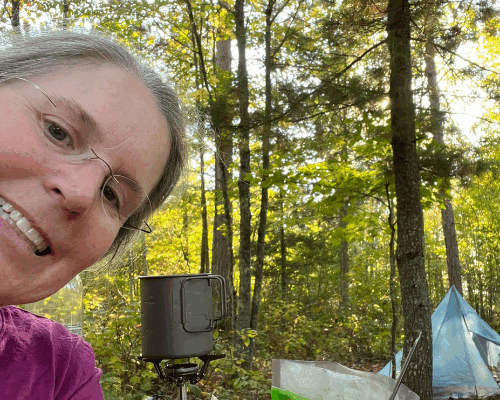
- I love my MSR camp cook stove! I can boil water for tea, cook a box of gluten-free macaroni and cheese in about 15 minutes, or heat water for dishwashing.
- Jetboil makes another excellent camp cook stove, though it is a bit more expensive.
- Solar ovens! I love the solar ovens that I create and sew, like this one. To use a solar oven, you just put the food inside, point the window toward the sun, and within an hour or two, you have cooked food. You can even bake things in a solar oven!
Snacks that don’t require heat
Another option for a cold meal is to whip up a shake or smoothie. I have this portable blender that works great as long as I can find an outlet to plug it in. Outlets are frequently available at rest stops, coffee shops, and campgrounds with electric sites, and sometimes you can talk a gas station attendant into letting you plug in for a minute. Here are some options for quick smoothies and shakes:
- 1 c. cold water, one squeeze pack of Sunbutter, one squeeze pack of MCT oil, and one scoop of Perfect Collagen Powder.
- 1 c. of canned coconut milk, ⅓ c. macadamia nuts, one scoop of protein powder, and 1 T. cocoa powder.
- 1 c. cold water, 1 T. coconut oil, and one scoop of Perfect Collagen Powder.
You need about a cup of liquid of choice, 1 T. fat, collagen peptide powder and/or protein powder, and some sweetener, if preferred. If you can score ½ c. of ice from a convenience store, it is even more refreshing. You get the idea.
I also like to make tea when I’m on the road, and this portable water boiler makes it easy.
Making hotel stays do-able
In this post, I talk about how I camp in my car. But sometimes I have no choice but to stay in a hotel when I visit an out-of-town medical provider. So, here are some tips for making that work:
- If you have a choice, ask for a room that is on the second floor from the top. That way, if the hotel has had roof damage, you will be a little safer one floor down from the top, where the worst damage is likely to have occurred. This is a pretty common issue because hotels usually have flat roofs, which are notorious for having water damage, especially in the northern and midwestern states where we get heavy snowfall. Please don’t take a room on the first floor, as they are typically noisier and may have water intrusion issues from flooding. Again, it may sound crazy, but hotels are not usually engineered to keep water out.
- Check the room as soon as you get the key and note if there is a smoke odor, bleach smell, or any other offensive odor. If it smells musty or smoky, go back to the desk and ask for a different room. Trust me, if you have a chronic illness, you will not be comfortable in a musty room because it likely has a water problem. Look under the sink in the bathroom (and kitchenette if there is one) for discolored (black or gray) plywood. Look for drips and puddles under sinks and around bathroom fixtures. If the bathroom or kitchenette has mildewed tile or grout on the countertops, again, ask for a different room. Bleach is never healthy to breathe, so if the hotel uses bleach to treat mildew, you still don’t want to stay in that room. If the room smells of potent cleaning agents or bleach, pick a different room. Peek behind the refrigerator if you can, and look for water leaks (if the fridge hasn’t been defrosted in a while or if the ice maker is broken).
- Feel the carpet with your hand to make sure it is not damp. Avoid rooms with en-suite hot tubs, as they often have wet carpets, which can lead to mold.
- If there is a pool in the hotel. In that case, you want to be situated as far away from it as possible to avoid noise, wet carpet from people coming from the pool, and the deleterious health effects of breathing indoor pool chemicals.
- Smell the sheets and towels. If you have multiple chemical sensitivities, you can become sick from sleeping on heavily fragranced sheets or strong cleaning supplies. Or better yet, call ahead of your arrival and ask the hotel if they can use fragrance-free linens in your room. Tell them that you react to fragrances in laundry detergents and cleaning supplies. When my family stayed at a resort, I was able to request fragrance-free linens and only hydrogen peroxide for cleaning the unit before we arrived. The housekeeping manager was super helpful and willing to make me feel comfortable once I described my multiple chemical sensitivities. There is no point in suffering through things that will make you sick on your vacation! The resort had its linens washed at an industrial off-site facility, but she was willing to re-wash the sheets for our bed without soap before we arrived.
- If possible, choose a room with a mini fridge and microwave, which will make food prep easier. But if you don’t have that option, you can:
- Bring your own hot plate or Instant Pot with you to cook (carefully!) in the bathroom. You can make a wide variety of dishes with a single burner or Instant Pot. Just remember to bring a hot pad, a spoon, other cooking utensils, a pot or pan (for the hotplate), a few plastic storage containers for leftovers, and anything else you will need for the recipe you are planning.
- Bring your own electric kettle to boil water for tea (hotel coffee makers are notoriously full of mold). I love this kettle!
- Bring your own electric cooler/refrigerator. I bought a power adapter for my car so I can chill my cooler the day before I leave on a trip, plug it into my car’s 12V outlet while I travel, and keep it running in the hotel during my stay. Food stays cold the whole time, and I don’t have to worry about finding ice to keep it cool on the road or emptying my cooler of meltwater.
- Bring the basics to cook and eat, such as a roll of paper towels, a set of silverware, a cup, bowl, and plate, dishwashing soap – I love CampSuds, a sponge, and a dish towel to dry your clean dishes on (or use hotel hand towels). If you forget silverware or dishes, you can always check the hotel breakfast bar, where you can often find plastic silverware and paper plates, bowls, and cups.
- If you have sensitivities to soaps and shampoos, then bring your own tolerated versions.
- If you absolutely can’t tolerate industrially washed linens (that’s been me at times), then I bring my own set of sheets, duvets, and towels.
- I always travel with a couple of large black trash bags to bag up whatever I find I can’t tolerate in the hotel room. Even when I request fragrance-free bedding, there may still be fragranced throw pillows, bedspreads, or shams on the bed that can irritate sensitivities. Bag them up when you arrive, then dump them back onto the bed before you check out.
- Bring a few extra kitchen-sized trash bags, too, because if you are preparing food, there will likely be food scraps, dirty paper plates, or wrappers sitting in your trash between housekeeping visits. That way, you can entirely bag up any trash with offensive odors and carry it to the dumpster yourself or to the housekeeping closet down the hall, where they usually have a trash collection bin.
- Bring a HEPA air purifier. I love my AirDoctor filter, and it is fairly transportable (even by sled!) I also use this car hepa filter because it is small and quiet, and fits in the vehicle’s cup holder. Even with fragrance-free linens and cleaning products, there will still be potential pollutants coming from the HVAC system, dust, dander, pollen, and possible mold spores. So it just gives me peace of mind to know that my air filter is catching whatever I don’t know about.
- Bring a small fan or a white noise machine to block out neighbors’ noise. I use a USB fan to sleep year-round due to hormone fluctuations.
- Shop for fresh local ingredients at food co-ops along your route. I like to pick up fresh salad greens every other day for my salads.
- Bring extras of all of your medications and supplements, and your rescue kit too. You can’t predict when you will need to stay an extra day or two due to weather delays or transportation issues. When you are off your usual routine you are more likely to experience a mast cell flare. Add to that the unknown triggers that you may encounter on your trip, disrupted meal schedules, and emotional triggers (even positive emotions can trigger mast cell flares!). You are just more likely to experience a symptom flare while traveling. My rescue kit contains my Epi-pens, extra rescue medications in pill pouches for when I’m having a flare, gloves, extra masks, a list of my medications (you never know when you’ll need it!), a couple of antivirals in case I catch Covid-19, a few Covid-19 test kits, and a copy of my rescue plan. The kit I use comes with inserts that I usually take out to make room for everything I need. You can also slip an ice pack into a day-trip bag to keep medications cool.
Traveling with MCAs definitely takes more advanced planning, but it can be totally worth it to get out of your regular routine and experience adventures on the road!
Use nervous system retraining tools
If you have MCAS, there is a good chance that you also have nervous system dysregulation. I use the Safe and Sound Protocol (SSP) for nervous system retraining every few months. And when I travel, I start doing the SSP before I depart to keep on an even keel. If it’s feasible, I do my SSP listening practice while I’m on the road and again when I return.
When you travel, you are exposed to invisible stressors that you don’t encounter at home. Using the SSP or other nervous system retraining methods is a tool to keep your nervous system balanced so you can enjoy your trip more!
Check out these circadian health tools!
I’m an affiliate with Bon Charge, a company that makes tools for circadian health, and you can receive 15% off your order with my coupon code BETSYL.
Bon Charge offers tools such as yellow– and red-tone blue-blocking glasses, red light therapy devices, PEMF mats, infrared saunas, and EMF-blocking products.
Sign up for the SSP!
I’ve found the Safe and Sound Protocol (SSP) to be the most helpful bottom-up healing strategy if your nervous system has been overloaded with toxic exposures, including mold or non-native EMFs, chronic infections, concussions, stress, or trauma. The SSP is a passive listening therapy that helps heal nervous system dysregulation. Many people with MCAS and other chronic conditions have nervous system dysregulation stemming from infections, toxic exposures, concussions, and trauma. The SSP is an easy-to-use app that lets you listen to specially filtered music for 30 minutes each day as part of a 5-hour cycle. Studies show the SSP has a profound effect on mental health and chronic conditions. Here’s a short podcast describing the Safe and Sound Protocol.
You can sign up for the SSP here!
Heal your mind!
While the SSP is a bottom-up, somatic therapy for healing the nervous system, the Sacred Self-Healing Method I offer is a top-down nervous system-healing modality that focuses on cognition, attention, perception, and emotion, using the mind’s higher functions. The SSP and the Sacred Self-Healing Method complement each other and together produce lasting results. Here’s a short podcast on my self-healing practice.
I provide one-on-one in-person and remote chronic illness and caregiver coaching, as well as Sacred Self-Healing Sessions based on the Sacred Self-Healing Method, a proven, novel co-creative healing modality detailed in my Books.
Order my books!
Here’s a short podcast highlighting my five books.
My latest book, Living In The Light: Healing with Forgiveness, Sound, and Light, is all about the tools that have been most helpful for me to heal: forgiveness, sound, through nervous system retraining using the Safe and Sound Protocol, and light, through entraining my circadian rhythm with the energy of the sun. Living In The Light is available here!
Rocks and Roots chronicles my solo backpacking journey on the Superior Hiking Trail and my efforts to overcome nervous system dysregulation, gut dysbiosis, and Mast Cell Activation Syndrome symptoms to complete the 328-mile hike successfully.
The Sacred Self-Healing Method ebook is available here and in most ebook retailers!
The Sacred Self-Healing Workbook is available for purchase here!
Betsy’s first book, Sacred Self-Healing: Finding Peace Through Forgiveness, is available here
Companion Recordings
The companion audio recordings of chants, guided meditations, and sound healing demonstrations that accompany the Sacred Self-Healing Method are available for free on my YouTube channel here
What do you think?
I’d love to have your reply below!
Disclaimer
The preceding material does not constitute medical advice. This information is for information purposes only and is not intended to be a substitute for professional medical advice, diagnosis, cure, or treatment.