


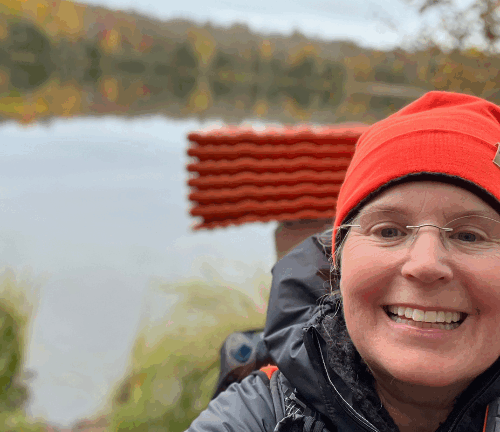
I’m a solo female backpacker with a chronic illness called Mast Cell Activation Syndrome (MCAS) who is section hiking the North Country Trail in Wisconsin. This post tells of my final 58-mile section on the NCT in WI.
As an Amazon Associate, I earn from qualifying purchases.
Table of Contents
Who is Betsy Leighton?
I’m a writer, blogger, and healer dedicated to helping individuals reconnect with their innate peace and wholeness by healing nervous system dysregulation. My personal experience with chronic illness called Mast Cell Activation Syndrome (MCAS) shapes my work, and my content offers tools to empower those with chronic illness to improve their well-being and take charge of their health.
I created the Sacred Self-Healing Method and am a trained and certified Safe and Sound Protocol provider, an author, blogger, and A Course in Miracles Teacher. I hold a Master of Divinity in Spiritual Counseling and am a trained spiritual mentor, with certificates in sound healing, aromatherapy, nutrition, and Sacred Deathcare. I offer a self-study certificate program in the Sacred Self-Healing Method, provide spiritual counseling and coaching, courses, and supported subscriptions for the Safe and Sound Protocol.
What is MCAS?
Mast Cell Activation Syndrome (MCAS) is a chronic condition that affects all organ systems. It can cause severe, disabling symptoms every day, including potentially fatal anaphylaxis.
The common triggers for MCAS are infections, toxic exposures including mold exposure and EMFs, trauma, concussions, and stress.
MCAS often occurs with other chronic conditions like Ehlers-Danlos Syndrome (EDS) and Postural Orthostatic Tachycardia Syndrome (POTS). Managing MCAS is challenging because many healthcare providers are unaware of it, and diagnostic tests can be unreliable. Treatments include antihistamines and mast cell stabilizers in the form of medications and supplements, along with avoiding triggers. Check out this post on managing MCAS.
Why the North Country Trail?
I solo backpacked the Superior Hiking Trail between June 2024 and August 2025, and it taught me a lot about my true strength. I published a book last November about the first two-thirds of my journey on the SHT.
Over fifteen months and 16 trips up north, my nervous system healed, my body got stronger, and I exploded the limits of my physical and mental capacity. I surpassed my longest distance record repeatedly – from five miles, to eight, then 17, and finally 38 miles in one day. I honed my gear and dropped several pounds of weight from my body and gear, refining my pack to be a comfortable extension of my body. I broke through my fears of solo backpacking, camping alone, interacting with bears, navigating with GPS, communicating my location by satellite, cooking satisfying homemade dehydrated meals that worked with my dietary restrictions, and over time, as each seeming limitation fell away, I grew.
This is my final section of solo backpacking the North Country Trail in Wisconsin, so read on to find what I learned along the trail!
Day 11 on the NCT in WI – Fall Splendor
Sunday night, I drove to the Fire Road 202 trailhead and camped so I would be ready on Monday morning. Trail Angel Dom, pick me up Monday morning at 9 AM, and he drove me to the junction where the North Country Trail crosses Highway 169 just before the town of Gurney. I set off on a dirt logging road to meet the trail. My map indicated that the official end of the Wisconsin NCT is at mile marker 197. I started roughly at mile marker 200.
The trail left the logging road, meandered into the woods, and was very well marked in this section, which is known as the Heritage chapter section of the North Country Trail in Wisconsin. I followed Chase Creek, which joined the Potato River for several miles, and I passed three beautiful campsites, stopping at one for a snack and to stretch. I passed a guided school group being led by a woman who introduced herself to me as the president of the Heritage Chapter. Since I was wearing an orange Northland College ball cap, she assumed I was from Ashland, as did the man at the end of the group. I clarified that I’m from the Twin Cities, that I am finishing my last section hike of the North Country Trail in Wisconsin, and that my daughter had attended Northland College.
The school group was comprised of about 24 college freshman-age young people, who were polite and interested in hearing about my hike. The two NCT leaders treated me like a trail celebrity and took a photo of me, which felt silly but fun. I continued along the river, passing several waterfalls, and topped up my water.
Road 202, where I left my car, is at approximately mile marker 143, which means this section will be 58 miles total. It’s my fourth and final section of the NCT in WI. I planned to spread it out over 4-5 days, depending on the weather. Temperatures were forecasted for the 40s at night and 50s during the day.
Miles 200 to 212 on the WI MCT to the Michigan border is entirely a road walk, which I am purposely avoiding. Even without that 12-mile road walk, this section still has about 5 miles of road walking, and as soul sucking as it is for me, I will avoid it.
Monday afternoon continued to be glorious fall weather. I passed several abandoned mines and bridges, covering a total of 14 miles, and ended the day at Wren Falls on the west side of the Tyler Forks River. The campsite was up on a bluff above the river, and absolutely gorgeous with the trees dressed in their fall splendor. I ate my dinner of rice noodles with almond butter, olive oil, and lime juice powder, and then retired to my tent at 6 PM.
The Wren Falls campsite is close to a parking lot, and despite being very pretty, it was a bit trashed. Previous campers had denuded the trees’ lower branches, and there was trash and other discarded items scattered around. With many branches gone, it was difficult to find a tree suitable to hang my food in, but I did manage to locate one and successfully hung my food before bed.
I was plenty tired and slept peacefully from about 7 PM to 3:30 AM when I woke feeling chilled. The temperature was forecast to be in the 40s overnight, but it had dipped down to 34 degrees during the night. My tent was perched on the bluff above the river, and I had forgotten about how camping above water causes much more condensation to form inside the tent. By the time I woke up in the wee hours of Tuesday morning, the inside of my tent was coated in moisture, and no matter what I tried, I couldn’t warm up. So I got up, ate breakfast, and was back hiking on the trail by 4:30 AM
Day 12 on the NCT in WI – Lost in the Dark
I woke up chilled on Tuesday morning and decided to make an early start to get my body moving and warmed up. I started hiking at 4:30 AM in the dark. The moonlight was quite bright, making it easy to navigate with my headlamp on low. I love hiking in the dark, and I peacefully traversed woods and fields until I emerged onto an unsigned, unnamed, active logging road.
Somewhere between Porcupine Hill East and Feldcher Creek, I completely lost the North Country Trail for about a half-mile in the dark. I had no cell signal at the time, and none of my GPS navigation apps (Avenza maps, the Gaia Map app, the Garmin Explore app, and the FarOut app) showed this section of trail–either they didn’t show enough detail, or did not show the NCT in this area. Even the interactive NCT online map did not show the name of the road I found myself on. The maps showed the trail simply crossing the logging road, but there was no entry point for the trail on the opposite side.
It appeared this was part of a new reroute of the NCT. There was no signage indicating when the trail stopped at the road, nor where the trail went westward from there. I muddled around in the dark cross cross-referencing landmarks on several maps, until I finally decided to take the road northwest. After about a quarter mile, the trail signage resumed and the trail reentered the woods going westward.
The area appears to be very heavily used by logging trucks, and the road was aggressively plowed into muddy banks on either side. If there had been any signage, it was plowed under a giant mud rut somewhere.
Continuing through the hardwood forest, I reached the vista above the Bad River at the beginning of Copper Falls State Park and stopped to rest at a post that was painted with the words “Northland College Students”. My daughter attended Northland College, and she had hiked at Copper Falls several times during her time at Northland. This appeared to be a stretch of trail dedicated to Northland College students. It was bittersweet, though, because the college closed for good last May. But it was a nice spot to rest with ample cell signal, where I could text my family and read my email. Cell signal has been very sparse up until that point.
I followed the trail meandering through hardwoods along the ridge and slowly descended to the Bad River into the Copper River State Park area. I hadn’t seen any hikers that day, but as I approached Copper Falls, there were quite a few day hikers. I used the restroom there, refilled my water, had a snack, and regrouped before continuing on past Copper Falls State Park.
It was frustrating because the trail markers were missing throughout the entirety of Copper Falls State Park, making it very tricky to stay on the NCT. There were a lot of crisscrossing State Park trails, and it seemed as though all the NCT signage had been taken down for maintenance. It was a bit frustrating trying to navigate through the area.
After the State Park, I passed over a long boardwalk in a slough and slipped into the town of Mellen. This part of Mellen was nothing special, though I was grateful that the road walk before the town was quite short on paved roads. After the town, there were a few miles on dirt roads. As I was leaving Mellen, a guy called out me because he wanted to tell me I was carrying a pack as big as the one he had carried when he was in the army. I wasn’t really sure how to respond to that, but I waved and smiled as I passed by.
After the roadwalk, the trail reentered the woods and then went through the Penokee Mountain Ski Trail System, which was also a bit confusing to navigate. I stopped to wild camp within the ski trail system about a mile and a half from English Lake at 6 PM. Rain had not been forecast, but it began to rain just as I stopped to camp. The weather app on my phone indicated the rain would taper off about midnight.
I had gone 25 miles that day, and I was completely exhausted; all I could do was set up my tent and collapse into sleep. No dinner. No brushing my teeth. I just crashed. I slept without moving from 6 PM to 10:30 PM, when I realized that one of my tent stakes had dislodged, and I had several inches of rainwater in the lowest corner of my tent right next to my head. I got out of my tent in the rain and repositioned the stake. Then I swept the water out of my tent with my hands and rested for another hour.
Day 13 on the NCT in WI – More Night Hiking
My initial plan had been to spread the 58 miles of this last section of the NCT in WI over four or five days. Typically, I spend three days out on the trail per 50-mile section, but I wanted to give myself enough time to comfortably complete it. So I packed meals and snacks for five days. My pack was about six pounds heavier than normal due to the extra food, my warmest sleeping quilt, an Alpha Direct quilt liner, a warmer hat, mittens, a blaze-orange vest (it’s hunting season), and merino wool long underwear.
I had gone 14 miles on Monday and 25 miles on Tuesday. Monday night’s uncomfortable low temperatures and Tuesday night’s rain had made me antsy to be off the trail today because it was forecast to be colder and rainier on Thursday. So I got up at midnight on Wednesday when the rain stopped, hoping to cover a considerable chunk of the 20 miles remaining to my car in the dark. I packed up my gear, and my tent was absolutely sopping wet from the heavy rain, but most everything else had remained dry-ish.
I hiked in the dark for six hours through rolling Chequamegon-Nicolet National Forest. I heard a few coyotes calling and some owls hooting, but there were no bears, elk, or wolves in evidence in the area. At 6 AM, I stopped to pitch my tent at the turn-off for the Beaver Lake campground. I was too tired to take the mile-long spur trail to the lake, so I just plopped down right in the middle of the trail at the turn-off and fell asleep immediately in my tent, hoping that it would dry a bit as I slept.
I woke at 8 AM, made tea, and ate breakfast. There hadn’t been much moisture evaporation, unfortunately, but I still had experienced a solid rest and now had food in my belly to continue to the finish.
I set off on the trail again westward toward Fire Road 202, where my car was parked. The leaf litter on the forest floor covering the trail was very wet from the rain, and I had sopping wet feet for the entirety of my hike on Wednesday. But luckily, with the merino wool toe socks I’ve been wearing, I did not get a single blister. However, I noticed when I changed socks that my feet were being dyed tea-color from the tannins leaching out of the leaves.
In addition to having brown feet, some other disgusting things happened on Wednesday, including finding a slug in my shoe after I woke up (luckily un-squished), finding another slug had been cooked on the bottom of my pot when I made tea, realizing I had stepped in dog poop at some point (hoping it was dog and not human), and the overall gross sense of being sopping wet and nasty for hours on end. I eagerly anticipated returning to my car, cleaning up, putting on clean, dry clothes, eating, and taking another nap.
As I completed the last leg of this 58-mile section of the North Country Trail in Wisconsin, I reflected on my experience. I saw the most day hikers of my whole hike on the NCT in Wisconsin on Monday, when I ran into several groups of day hikers, including the school group led by the Heritage chapter president. Tuesday, I didn’t see any other souls on the trail other than at Copper Falls, and Wednesday, zip. So, all in all, I’d seen under thirty people over 200 miles, with 90% of them in one day, and I’d only seen a total of two thru-hikers.
My experience of the NCT in WI had included many beautiful vistas, stunning fall foliage, very well-maintained trails (with the two notable exceptions yesterday), and very little trash. I’d met very friendly trail stewards and volunteers, and I’d been impressed with how warm, welcoming, and devoted the local chapter members are to making hikers feel comfortable and welcome. I received rides from kind trail angels to each of the trailheads, and I noted how invested volunteers were in making my experience successful. It was inspiring to see how many people volunteered their time, energy, and talents to the trail.
In this particular section, I remembered that I prefer to camp in temperatures above 40 degrees, and that all things being equal, I’d rather not camp in pouring rain. My gear kept me warm and dry, but there are always little hiccups, like when my tent leaked, that can’t be avoided.
I set out with my plan to solo-backpack the 200-mile section of the North Country Trail in a bid to become a trail correspondent for ULA Equipment. I didn’t land the trail correspondent position, but I still got a lot out of the experience of applying, including realizing that I’d solo backpacked over 1200 miles in the previous twelve months, and gaining perspective on how I’ve grown into a badass solo female backpacker. I know I can cover up to 38 miles in a day if necessary, 20-ish is not too hard, and I can knock off 15 miles now with no problem. I won’t get anything from promoting them, but I still love my ULA Equipment backpacks. They keep my gear dry and secure, and they are always comfortable.
So, now that I’ve completed the 300-mile Superior Hiking Trail in Minnesota and the 200-mile NCT in Wisconsin, what’s next, you ask? Well, I’m eyeing the Border Route and Kekekabic sections of the North Country Trail in northern Minnesota for next summer. The NCT extends from North Dakota to Vermont, so there will be plenty of other sections to keep me busy! Thanks for following along, and see you out there on the trail!
The bucket theory
The bucket theory simplifies understanding symptom reactions with MCAS. Imagine your body as an empty bucket you don’t want to overflow. Reactions to various stimuli fill the histamine bucket at different rates, forming the total histamine level (how full your bucket is). More histamine means more symptoms. By managing triggers, reducing exposures, and taking medications and supplements, you can control your bucket’s level.
Know your typical symptom progression
Understanding your symptom progression during a flare is key to developing your rescue plan. This post discusses how to recognize symptom progression so you can be prepared to address them.
Get my free ebook, symptom log, and meal plan!
Want a tool to easily track your symptoms?
Check out these circadian health tools!
I’m an affiliate with Bon Charge, a company that makes tools for circadian health, and you can receive 15% off your order with my coupon code BETSYL.
Bon Charge offers tools such as yellow– and red-tone blue-blocking glasses, red light therapy devices, PEMF mats, infrared saunas, and EMF-blocking products.
Sign up for the SSP!
I’ve found the Safe and Sound Protocol (SSP) to be the most helpful bottom-up healing strategy if your nervous system has been overloaded with toxic exposures, including mold or non-native EMFs, chronic infections, concussions, stress, or trauma. The SSP is a passive listening therapy that helps heal nervous system dysregulation. Many people with MCAS and other chronic conditions have nervous system dysregulation stemming from infections, toxic exposures, concussions, and trauma. The SSP is an easy-to-use app that lets you listen to specially filtered music for 30 minutes each day as part of a 5-hour cycle. Studies show the SSP has a profound effect on mental health and chronic conditions. Here’s a short podcast describing the Safe and Sound Protocol.
You can sign up for the SSP here!
Heal your mind!
While the SSP is a bottom-up, somatic therapy for healing the nervous system, the Sacred Self-Healing Method I offer is a top-down nervous system-healing modality that focuses on cognition, attention, perception, and emotion, using the mind’s higher functions. The SSP and the Sacred Self-Healing Method complement each other and together produce lasting results. Here’s a short podcast on my self-healing practice.
I provide one-on-one in-person and remote chronic illness and caregiver coaching, as well as Sacred Self-Healing Sessions based on the Sacred Self-Healing Method, a proven, novel co-creative healing modality detailed in my Books.
Order my books!
Here’s a short podcast highlighting my five books.
My latest book, Living In The Light: Healing with Forgiveness, Sound, and Light, is all about the tools that have been most helpful for me to heal: forgiveness, sound, through nervous system retraining using the Safe and Sound Protocol, and light, through entraining my circadian rhythm with the energy of the sun. Living In The Light is available here!
Rocks and Roots chronicles my solo backpacking journey on the Superior Hiking Trail and my efforts to overcome nervous system dysregulation, gut dysbiosis, and Mast Cell Activation Syndrome symptoms to complete the 328-mile hike successfully.
The Sacred Self-Healing Method ebook is available here and in most ebook retailers!
The Sacred Self-Healing Workbook is available for purchase here!
Betsy’s first book, Sacred Self-Healing: Finding Peace Through Forgiveness, is available here
Companion Recordings
The companion audio recordings of chants, guided meditations, and sound healing demonstrations that accompany the Sacred Self-Healing Method are available for free on my YouTube channel here
What do you think?
I’d love to have your reply below!
Disclaimer
The preceding material does not constitute medical advice. This information is for information purposes only and is not intended to be a substitute for professional medical advice, diagnosis, cure, or treatment.