
After completing five hours of the SSP Core Pathway I’ve been noticing some fairly significant shifts, like a more consistent awareness of my patterns to protect myself in everyday life. I’m connecting the understanding of how these patterns are no longer necessary in real time. – MG
What is the SSP?
The Safe and Sound Protocol (SSP) is a listening therapy based on Polyvagal Theory that uses filtered music to support the inner ear, regulate the nervous system, and repair trauma pathways. It is helpful for conditions such as PTSD, chronic illness, ADHD, autism, and chronic illness.
I’ve blogged about my personal experience with the SSP here, here, and in my latest book, Living In The Light.
Check out this 3-minute podcast on the Safe and Sound Protocol!
Table of Contents
Signing up
- Click here to sign up.
- Cost: $250 (sorry, HSA/FSA accounts cannot be used to pay for the SSP.)
- Complete the Intake form
- Betsy will create your MyUnyte account, and you will receive an email asking you to log in to MyUnyte and set a password
- Complete the brief online assessments sent to you from MyUnyte
- You can listen to the different music genres here: https://integratedlistening.com/products/ssp-safe-sound-protocol/ssp-music/
What is included?
The Safe and Sound Protocol (SSP) subscription with Betsy includes:
- An intake session with Betsy to determine your needs.
- One-year access to the SSP UnyteHealth App with specially filtered music.
- Follow-up check-ins to answer questions and adjust your program.
- Follow-up assessments to fine-tune your program.
After completing your intake, you will receive an emailed link to create a MyUnyte account and complete brief online assessments. Then, Betsy will develop a personalized SSP listening plan based on your needs. This plan may evolve as you listen, and Betsy will collaborate with you to review progress and make adjustments as necessary.
A Passive Listening Program
Because the SSP is a passive-listening therapy, you do not have to “do” anything beyond listening to experience its benefits.
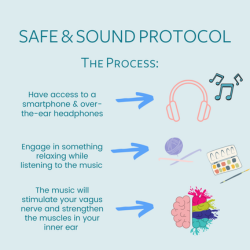
The UnyteHealth app provides your SSP listening program, including 5 hours of filtered Core Pathway music and 5 hours of less-filtered Balance Pathway music. You listen for 30 seconds to 30 minutes a day, starting with the Core Pathway. After completing the Core Pathway, you switch to listening to the Balance Pathway for up to 30 minutes daily, then take a 30-day break. The MyUnyte app shows a timer for each session, helping you track how long you listen.
Depending on the degree of dysregulation in your nervous system, your starting point may be as little as 30 seconds per day, gradually increasing to 30 minutes. Regardless of how much listening your nervous system tolerates, you’ll still gain the benefits of toning your inner ear muscles and retraining your nervous system to feel safe.
Choosing headphones or speakers
The SSP is best delivered via speakers or over-the-ear headphones.
Computer speakers like these are compatible with the SSP.
Keep in mind that anyone in the listening environment will receive the SSP music just as the intended listener would.
Here is my suggested type of over-the-ear headphones compatible with the SSP:
Over-the-ear headphones are recommended because they provide an immersive listening experience. Because the vagus nerve branches to the eardrum and external ear, over-the-ear headphones maximize input to the vagus nerve by covering the whole ear.
On-the-ear headphones and earbuds are not recommended because they often have built-in controls for adjusting various sound frequencies. Earbuds only bring input to the internal auditory canal and eardrum.
Noise-canceling headphones are not recommended unless the feature can be turned off.
Choose a safe, quiet environment
Choose a space where you feel safe, relaxed, and comfortable for your SSP listening sessions. Start and finish each SSP session in a sense of safety. Avoid noisy, stressful, or highly stimulating environments.
Significant life events or other stressors
Stressful life events, like illness, injury, surgery, job or school changes, medication adjustments, or other stressors, can strain your nervous system. Starting the SSP during or immediately after significant life events may require some adjustments to your listening program. You can adjust your listening program based on how your nervous system responds. The SSP can also be supportive during stressful times.
Sleep
The SSP can stimulate your nervous system, making you feel more alert. If you have trouble falling asleep or staying asleep, it’s best to do your SSP listening practice in the morning.
30-Second reset
If you ever experience a time of nervous system dysregulation, such as anxiety, a symptom flare, a trauma loop, or anything similar, try doing what is called a 30-second reset. Listen to the Core music for 30 seconds and then stop. The 30-second reset can be done at any time (even during the 30-day rest period) to help reset your nervous system.
Social support
Polyvagal Theory tells us, “We are wired to connect.” It is the connection with others that offers greater potential for nervous system balance. Having access to support — such as family, friends, pets, and nervous-system-regulating activities — will increase the likelihood of the SSP’s success.
Volume test
Before each listening session, you’ll be guided to check the volume in the app and set it to the lowest comfortable level. The music might seem quiet during some parts, but you should resist the temptation to turn the volume up.
Monitoring
Betsy will monitor your listening progress through the MyUnyte portal and assist with any necessary program adjustments. She will also check in with you periodically via text or email to see how the SSP is going. If you need to contact Betsy, email [email protected] or text 612-306-9548.
Responses
You can respond to the SSP in several ways. Autonomic shifts may trigger thoughts, feelings, and sensations as you go through the SSP experience. As with any therapy, brief changes in arousal and discomfort might happen.
It’s important to stay present and notice the ‘whispers’ of your nervous system before they turn into ‘shouts.’ When you first observe something coming up:
- Pause the music and ask yourself if you can ‘be with’ the sensation or feeling. Or in autonomic terms, can you stay regulated throughout the experience?
- Ask yourself how you’re feeling and what emotions or sensations you notice. Try to locate the sensation in your body or describe the emotion.
Remember that nervous system ‘regulation’ doesn’t mean always being regulated; it means having the ability to respond flexibly to challenges or stressors. If dysregulated energy arises, consider engaging in nervous system-regulating activities to boost your capacity.
Here is a link to download a pocket guide to nervous system regulating activities:
Power of the pause
Pauses are opportunities for healing and reconnecting to safety. Over time, the SSP helps form new neural pathways and connections, making self-regulation easier. Nervous system activation doesn’t always mean you need to pause or end the session. When you notice an autonomic shift, observe for a few seconds or minutes before responding. This gives the nervous system time to process the shifts.
Discomfort
Although rare, some clients report sensations that can be uncomfortable—these are usually temporary and may include:
- Sound or other sensory sensitivities;
- Ear discomfort, pressure, or ‘ringing’ in the ears;
- Emotional dysregulation or shifts in arousal;
- Gastrointestinal discomfort;
- Fatigue or headaches;
- Temperature dysregulation or other neurological symptoms.
If these or other uncomfortable sensations occur, pause the music and try shaking (see Nervous System Regulating Activities) or use another regulating activity. If the discomfort persists, it may be best to end the session that day and contact Betsy. It’s better to stop listening during discomfort, even briefly, to do a regulating activity than to push through it.
Client factors that inform complexity
Betsy will determine your level of nervous system dysregulation based on your assessments.
Low-complexity clients have good overall health, limited impact of trauma, no significant sensory differences, established regulatory capacity, and access to support and resources.
High-complexity clients have poor overall health, impactful trauma history, notable sensory differences, limited regulatory capacity, and restricted access to support and resources.
There are many ways to structure your listening program, depending on your nervous system’s state of regulation. Below are two example listening programs for your reference. Your program will be tailored to your specific nervous system.
Sample Listening Program for a higher-complexity client:
| 5 minutes of Core per day for 60 daysfollowed by5 minutes of Balance per day for 60 days, 30-day break |
Sample Listening Program for a lower-complexity client
| 30 minutes of Core per day for 10 daysfollowed by30 minutes of Balance per day for 10 days, 30-day break |
Nervous system regulating activities
You can incorporate nervous system-regulating activities into your listening session to help your body process the experience, or anytime you feel dysregulated. These activities can include gentle movement, simple puzzles, coloring, clay, or other creative tasks. Child clients may enjoy quiet floor play with toys such as building blocks, toy cars or trains, playdough, or coloring books. If having your pet nearby helps regulate your nervous system, it’s fine to have them present during your session. However, if your pet seeks your attention while you’re listening, it’s best to do your practice in a separate space. Screens, cognitively demanding tasks, and high-intensity exercise are generally not recommended because they can stress the nervous system. For some clients, movement can help safely mobilize through sensations. Be aware that sudden bursts of movement may indicate activation.
Here is a link to download a pocket guide to nervous system regulating activities:
Shaking
Shaking is a powerful nervous system-regulating activity. Animals shake after a traumatic event to release tension and regulate their nervous system. Shaking is a natural biological response that signals to the brain that danger has passed and the fight-or-flight response can be turned off. Shaking releases energy. It helps animals discharge the energy from a traumatic event and release muscular tension, burning off excess adrenaline. Shaking is a natural way to restore the body to normal homeostasis.
Humans can also shake to release tension and trauma. To shake to release trauma energy:
- Get up and gently shake your body from side to side or up and down. Or shake your arms and hands while sitting.
- Allow the shaking to happen naturally.
- Take slow, deep breaths as you shake.
- Focus on releasing tension or stress with each breath.
- Continue shaking for up to five minutes, or until you feel regulated again.
Shaking can be used if you notice nervous system activation during an SSP listening session. Simply pause the program and shake your body.
Here is a video demonstrating ear massage as well:
https://www.youtube.com/watch?v=LnV3Q2xIb1U
Tips for getting the most out of the SSP
Here are some additional tips for having successful SSP listening sessions:
- Choose an environment where you feel safe, relaxed, and comfortable to do your listening sessions.
- Begin and end each SSP session in a safe place.
- Figure out your preferred listening style. Try using the SSP while taking a gentle walk to see whether you prefer to listen while moving. Try coloring in a coloring book while using the SSP to know if you prefer that. Or try other peaceful activities such as knitting, beading, sculpting, or other creative activities while listening. The activity should be in the background while your listening practice is in the foreground, so reading, watching TV, or using screens is not recommended.
- For seated listening practice, sit up and remain alert. Don’t eat or work while listening. Drinking is fine. Do not use screens while listening.
- Gentle movements such as rocking, stretching, self-massage, breathwork, sitting on a therapy ball, and vocalizing can help regulate your nervous system if you notice it is activated.
- Some colored pencil and marker sets include dozens of colors, which can be overwhelming for some users. If you are too activated by coloring with multiple colors, start with one color (monochromatic). Over time, you will have more capacity to color with various colors. Or try coloring with your non-dominant hand.
- Journal about your progress after each listening session. You can also keep a diary of your symptoms and see how they change throughout your listening program.
Why nervous system regulation essential for your well-being?
The autonomic nervous system regulates essential bodily functions. When you feel in danger, this system kicks in to protect you by engaging the “fight/flight” or “freeze” responses. You may be able to identify when your autonomic nervous system is in a defensive state if you notice difficulties with:
- Sleep
- Concentration
- Mental clarity
- Breathing
- Digestion
- Social connection
Benefits of nervous system regulation
The benefits of nervous system regulation include:
- Improved response to stress – Better respond to challenging situations and move past them instead of reacting and getting “stuck” in them
- Ability to access higher learning and cognition – Become attuned to and more in control of emotions so that you can move through temporary setbacks with more flexibility and ease.
- More social connection and deeper relationships—By activating the part of the brain that enables you to be more social, affectionate, and connected, the SSP can help you feel more comfortable and at ease engaging with others, leading to deeper, more meaningful relationships.
How it works
The SSP’s music has been filtered to highlight sound frequencies that typically evoke a sense of safety. Higher and lower frequencies are associated with trauma, and people in a chronic state of activation are unable to hear the middle frequencies of sound. The SSP exercises the muscles of the inner ear and tones the eardrum so that you can hear middle frequencies by sending “cues of safety” directly to the nervous system.
The SSP is safe and effective for all ages
The SSP has helped over 100,000 children, adolescents, and adults in more than 70 countries worldwide. It can also be used with animals. Here is a link to SSP research studies and evidence of efficacy:
https://integratedlistening.com/resources/real-world-evidence
The SSP helps with chronic conditions
In addition to MCAS, the SSP Supports Many Symptoms and Conditions. The SSP may help reduce symptoms and support overall health and resiliency for people seeking support for:
- Trauma history
- Depression and anxiety
- Autism, hyperactivity, and attention
- Chronic pain
- Chronic health conditions
- Sensory and auditory processing
- And more
SSP principles
The Safe and Sound Protocol is a powerful tool for supporting nervous system regulation. The SSP helps heal your nervous system, making it more flexible and resilient. If your nervous system is activated, you may experience physical, mental, and emotional discomfort, such as a rapid heart rate or breathing, gastrointestinal discomfort, feeling overwhelmed, feeling shut down, or feeling numb.
To make the most of your SSP experience, you will use the following principles:
Safe Before Sound
Listen to your internal cues. If you feel agitated during an SSP listening session, consider stopping the program to assess how you feel. It may be good to take a brief break. You can use regulating activities to help your nervous system move through the discomfort (see Regulating Activities in the next section). If you are unable to continue listening, stop the program and contact Betsy.
Less is More
The SSP cannot be delivered too slowly, but it can be delivered too quickly. Start with shorter sessions before working up to a full 30-minute listening session.
Stretch and Savor
Gradually ‘stretch’ your nervous system’s tolerance to the SSP and ‘savor’ the results of those efforts. This is opposed to ‘stressing’ the nervous system and pushing it into ‘survival’ (a state of defense). You can pause, take breaks, incorporate nervous-system-regulating activities, or end a listening session as needed.
My experience with the SSP
I have used the SSP since November 2023. Nervous system dysregulation was at the root of my chronic illness, and the SSP was instrumental in putting it into remission. Before starting the SSP I tried many different trauma healing programs, limbic system and vagus nerve healing therapies, and nervous system retraining programs including Eye Movement Desensitization and Reprocessing (EMDR), Somatic Experiencing, Frequency Specific Microcurrent (FSM), Emotional Freedom Technique (EFT), Dynamic Neural Retraining System (DNRS), Cranio Sacral Therapy, Osteopathic Therapy, and others. However, SSP was by far the most straightforward, easy to use, and effective of these therapies.
My worst symptoms were chemical sensitivities, food sensitivities, neuropathy, temperature dysregulation, migraines, inflammation, and pain. I also had trauma loops that were interfering with my everyday happiness. My nervous system healing took place in stages, with a physical symptom healing, and then I would notice more mental and emotional resiliency. When I started the SSP, I was taking dozens of medications and supplements to manage my symptoms, I couldn’t eat more than 12 foods, and I couldn’t exercise due to pain and inflammation.
Over time, I regained the ability to eat almost all foods (I still avoid gluten and sugar), and I was able to cut back the number of medications and supplements significantly. I had less and less sensitivity to environmental triggers, my mast cell symptom flares reduced considerably, and my pain and inflammation disappeared.
After six months of the SSP, I was able to resume listening to music in the car, which had previously been too dysregulating for me. I began a regular exercise routine for the first time in decades, and I even solo backpacked over 300 miles.
A year after starting the SSP listening program, I began to feel joy in my life again. It was surprising because I hadn’t realized it was gone.
The SSP is backed by decades of research
The SSP’s effectiveness has been demonstrated across a wide range of clinical studies, including trials involving children and adults with autism. Real-world evidence has also shown significant improvements in the following areas after the SSP: Learn more and see full results here.
61% of clients with anxiety symptoms moved from clinical to non-clinical level
54% of clients with depression symptoms moved from clinical to non-clinical level
63% of clients with trauma-related symptoms moved from clinical to non-clinical level
47% of clients experiencing psychosocial challenges moved
The SSP works with other therapies
The SSP can be combined with and is supportive of other therapies that you may already be engaged in, such as:
- Occupational, physical, and speech therapy; play therapy; and sensory integration therapy
- Mental health and trauma therapies, such as EMDR, Somatic Experiencing, and Internal Family Systems (IFS)
- Talk therapy (CBT, DBT, MCBT, etc.)
- Bodywork, yoga, and other somatic approaches
Multiple playlists
Genres include popular, classical instrumental, and ambient music, offering both vocal and nonvocal, trauma-sensitive options. The playlists are suitable for all ages. Each pathway has unique qualities and can be used in different ways depending on how your nervous system functions.
- SSP Core is the original, filtered music program and potentially the most impactful of the three pathways.
- SSP Balance offers an integrated experience and the opportunity to extend the state-regulating benefits of the SSP Core.
- SSP Connect is unfiltered music for those who need to gradually habituate to listening to music
You can listen to the different music genres here: https://integratedlistening.com/products/ssp-safe-sound-protocol/ssp-music/
SSP Core (5 hours)
The SSP Core pathway progressively filters and dynamically generates music. It is the strongest pathway in the SSP. It can help reduce sound sensitivities and improve auditory processing, behavioral state regulation, and social engagement. Because the music progresses dynamically, clients must listen in order and avoid repeating any sections until the program is complete.
SSP Balance (5 hours)
The SSP Balance pathway has lighter filtration than SSP Core and does not progress dynamically, so it can be listened to in any order and repeated as needed. SSP Balance can be used as a ‘state shifter’ to help you return to a calm state if you find your nervous system is activated.
Program completion
For some clients, completing the program means listening to all five hours of the SSP Core and Balance programs in one sitting. However, the SSP is an ongoing process, and its benefits expand with repetition. Many clients repeat the SSP Core pathway several times a year and use the SSP Balance pathway in between for continued gains. The SSP is a subtle therapy that helps you build resilience through repeated practice. It is generally recommended to take a 4-6-week break after completing an SSP Core program, especially on the first attempt. Betsy will follow up with you after you finish your first listening session and may suggest adjustments.
Listen from almost anywhere
You can listen to the SSP’s music remotely from home, providing flexibility and convenience. You will need an internet or data connection while using the app.
The autonomic nervous system (ANS)
A regulated nervous system is essential for your physical and psychological health and well-being. The central nervous system includes your brain and spinal cord, while the peripheral nervous system consists of your somatic and autonomic nervous systems.
The primary function of the autonomic nervous system is to keep you alive, especially during stress responses. It controls vital bodily processes, including heart rate, breathing, and digestion. The ANS operates below conscious awareness, meaning it functions without you having to think about it. It helps regulate key body functions, such as heart rate, blood pressure, breathing, and digestion.
The vagus nerve is crucial in the ANS, transmitting signals between the brain and the body. When functioning properly, your nervous system responds to stress in a balanced way, efficiently using internal resources to maintain homeostasis. However, chronic stress can alter how the nervous system manages your bodily functions and can reduce your ability to engage socially and think clearly.
The sympathetic, “mobilized” state is one of activation and action. This state drives your defensive response, preparing you to fight or flee. In this condition, you are on high alert, which can make it harder to connect with others and can limit access to higher cognitive functions. Nevertheless, the sympathetic state can have positive qualities.
The dorsal vagal, parasympathetic “immobilized” state is characterized by shutdown or collapse, a last-resort survival response when the sympathetic response is ineffective. In this state, you feel disconnected and collapsed, often experiencing hopelessness and helplessness. The dorsal vagus also has healing qualities, helping you restore internal resources and recover from illness, injury, trauma, or other stressors.
Although each state has distinct qualities, they exist along a continuum. You often experience blended states, where responses are influenced by more than one state. These include experiences of play, freeze, and stillness. Play can emerge when sympathetic energy is balanced by ventral energy. Freeze results from the interaction of the sympathetic and dorsal systems. Stillness can be experienced when both ventral and dorsal energies are active and
proportional.
Connecting with the vagus nerve
The autonomic nervous system depends on a crucial nerve for your overall health: the vagus nerve. This is the longest cranial nerve, extending from the brainstem to the stomach. It’s often called the mind-body connector. The vagus nerve transmits signals between the brain and the body, helping you respond to changes within and outside your body.
The vagus nerve also relays the state of your autonomic nervous system to the brain. Stephen Porges, Ph.D., explains this through his Polyvagal Theory, which is widely recognized as a significant scientific breakthrough. It has transformed your understanding of how the body reacts to stress and trauma. Polyvagal Theory offers a framework for understanding how the autonomic nervous system functions today.
Brain retraining
Brains are plastic, meaning that they can be changed, and you can learn new ways of approaching things at any age.
Bottom-up (or body-based) nervous system retraining approaches include mindfulness practices, deep breathing, relaxation techniques, and the Safe and Sound Protocol.
Bottom-up healing is based on the understanding that trauma is stored not only in the mind but also in the nervous system and body tissues, in sensations, reflexes, and patterns of tension or shutdown.
Top-down trauma healing is an approach that begins with the mind and cognitive processes—helping you understand, reframe, and make sense of traumatic experiences through thinking, reflection, and language.
It’s called “top-down” because it works from the higher brain (the cortex) downward to influence the brain’s emotional and body-based systems (the limbic system and brainstem).
In the top-down trauma healing approach, understanding and insight help the nervous system regulate and make sense of what happened.
My favorite type of top-down trauma healing is using forgiveness practice, as done in the novel co-creative therapy I developed called the Sacred Self-Healing Method.
Top-down therapies help integrate traumatic memories into a coherent story, build understanding and meaning, strengthen emotional vocabulary and communication, encourage agency and perspective, and reduce shame and self-blame through insight.
Nervous system retraining
Nervous system retraining can help restore balance between the sympathetic and parasympathetic systems and support healing.
Nervous system retraining uses neuroplasticity techniques to reprogram the brain and nervous system to respond differently.
Neuroplasticity aids in healing
Sensory pathways within your nervous system help you interpret your environment. Similarly, your ability to regulate emotions influences your capacity to process sensory input, think, learn, and communicate with others.
The good news is that your brain and nervous system are plastic, meaning they can change. The Safe and Sound Protocol (SSP) can help re-pattern sensory pathways to improve how they process and respond to your environment. While you can’t control external situations or obstacles, you can change how your brain and nervous system respond to them.
Combining top-down and bottom-up healing strategies
A successful approach to nervous system dysregulation combines bottom-up (body-based or somatic) and top-down (cognitive) techniques.
I offer two powerful, complementary tools to guide your journey to peace and well-being: the Sacred Self-Healing Method and the Safe and Sound Protocol (SSP).
My fifth book, Living in the Light: Healing with Forgiveness, Sound, and Light, discusses how combining forgiveness, sound (through nervous system retraining using the Safe and Sound Protocol), and light (through entraining your circadian rhythm with the energy of the sun) facilitates healing. New AAP subscribers receive a free copy of the book (while supplies last).
These combined approaches can help you heal from chronic illness, emotional and physical pain, and a feeling of separation from your source, ultimately leading to trauma recovery and peace through forgiveness.
- Safe and Sound Protocol: This is a bottom-up listening therapy designed to heal nervous system dysregulation, concussions, and trauma.
- Sacred Self-Healing Method: A top-down mind-retraining therapy focused on helping you come to terms with the circumstances of your life.
In essence, top-down healing helps you understand your trauma, while bottom-up healing helps your body feel safe again.
In my trauma-healing practice, I teach clients how to use the Safe and Sound Protocol (bottom-up) and my Sacred Self-Healing Method (top-down) to address both ends of the issue.
The ear is the portal to the brain
The Safe and Sound Protocol (SSP) affects the nervous system through specially filtered music, activating the auditory neural network, including the vagus nerve. The SSP trains the auditory processing system to recognize safety cues signaled by the frequencies of human speech, thereby stimulating the social engagement system through the neural network involved in listening.
Polyvagal theory
Dr. Stephen Porges’ Polyvagal Theory has revolutionized the way you view the body’s response to stress, considering the autonomic nervous system (ANS) the foundation of your lived experience. Initially, you viewed the body’s reaction to stress as binary: we’re either in a sympathetic or parasympathetic state. Polyvagal Theory, however, shows that there are multiple and blended states of arousal in response to real or perceived stress. In simpler terms, Polyvagal Theory helps you understand how you engage in and interact with the world.
Hierarchy
The Polyvagal principle of hierarchy, sometimes called the autonomic ladder, explains the different physiological states that the vagus nerve can lead you to, depending on cues of safety or danger in your environment:
Ventral Vagal
In this state, your social engagement system is active in the ventral vagal pathway of the parasympathetic branch. Your nervous system is regulated, and we’re ready to connect and engage with others and what we’re experiencing in the now while tuning out irrelevant stimuli. You feel safe and secure in the world.
Sympathetic
This state of the ANS activates when you feel a stirring of unease, when neuroception triggers a sense of danger. You feel the need to take action to avoid or resolve the perceived threat, which triggers the fight-or-flight response. The world feels dangerous or overstimulating.
Dorsal Vagal
A primal part of the human experience, the dorsal vagal pathway is the path of last resort—a place of immobilization when the sympathetic response is insufficient to protect you or eliminate the perceived threat. In this state, a sense of hopelessness may take over, and your mind and body move into a state of conservation. You feel disconnected from yourself and the world.
Neuroception
Neural circuits are a group of neurons interconnected by synapses. Their primary role is to execute specific functions, but only when activated. Neuroception, coined by Dr. Porges, is how neural circuits in your ANS, via your senses, subconsciously decide in every moment whether a person or situation is safe, dangerous, or threatening, without involving the thinking parts of your brain. Neuroception listens to three streams of input: inside (the body), outside (the environment), and between (others’ nervous systems).
Co-regulation
As humans, you long to be connected to others: it’s a biological imperative that you are born with that develops and lasts throughout your lifetime. Co-regulation describes how your nervous system looks for and needs others with whom you feel safe enough to connect and with whom you can create supportive and protective relationships.
Co-regulation begins with the shared experience between a developing baby and its mother. Before birth, the baby hears its mother’s voice, which becomes a sound of safety. As an infant, it pairs the voice with a parent’s smiling face, and later, as a toddler, it can look to them for regulation (after falling, for example). Conversely, a lack of emotionally safe and nurturing relationships in childhood reduces the likelihood that children will become happy, healthy, independent, and resilient adults.
Contraindications
The SSP may not be suitable for clients with the following conditions. Please let Betsy know if you have any of these conditions:
- MODULATION DISORDERS (i.e., Bipolar, Borderline, and Dissociative disorders)
- CONDITIONS RELATED TO THE STRUCTURES OF THE EAR (i.e., Perforated or ruptured eardrum, stapedectomy, tympanostomy tubes)
- PSYCHOSIS; ANTIPSYCHOTIC MEDICATION; RECENT PSYCHIATRIC HOSPITALIZATIONS
- SEIZURES
- SEVERE HEARING SENSITIVITY (i.e., misophonia or hyperacusis)
- SELF HARM
Disclaimer
The preceding material does not constitute medical advice. This information is for information purposes only and is not intended to be a substitute for professional medical advice, diagnosis, cure, or treatment. Always seek advice from your medical doctor.
Sign Up Now!
You can sign up to receive the SSP and get started here!
SSP FAQ
What if I have hearing challenges and use hearing aids, cochlear implants, or bone-anchored hearing aids?
The SSP can still be used if you have hearing challenges. Your provider can work with you to find a way to do the listening program, including using speakers to facilitate listening with your hearing devices.
Cost
Betsy works remotely from Minnesota. The cost is $250 for 1 1-year subscription to the app, including the intake session with Betsy, the app, and follow-up check-ins. If you need additional counseling or coaching beyond that, it is billed at $100 per hour.
You will also need a device for the app (iOS or Android) and either speakers or over-the-ear headphones that do not have noise-cancelling.
How to listen?
You listen with your own over-the-ear headphones using the app. It’s best to practice listening in a quiet, safe environment.
I’d like to talk to you more before committing
Click here to schedule a free info session to discuss your questions.
How long is the listening practice
The Core Program is the most filtered and therapeutic, with 5 hours of listening. The Balance Program is less filtered and is also 5 hours of total listening. The Balance Program can be used to integrate the Core Program’s nervous system-healing and to calm the nervous system during times of activation. Both Programs are included in my $250 annual fee.
How long you can listen each day depends on your level of nervous system dysregulation. Some people can listen for only 10 seconds a day; the typical amount is 5-15 minutes. With less nervous system dysregulation, you can often listen for 30 minutes a day. After your intake session with Betsy, she will send you a few brief online assessments to determine your level of nervous system dysregulation. Betsy will then design a listening program for you that can be tweaked as we see how you respond.
What is the program?
Once you complete the first 5 hours of the Core Program, you can do another 5 hours of Balance to integrate it. After you complete the cycle of 5 hours of Core and 5 hours of Balance, you typically take a 30-day break and then start the cycle over. Your specific listening program will be tailored to your symptoms and level of nervous system dysregulation, so it may look very different from another client’s program.
The amount of listening each client tolerates depends on their level of nervous system dysregulation.
Less is more: It’s less about powering through the listening and more about meeting your body where it can take it in therapeutically.
When do you notice results?
People start seeing results with whatever amount of listening they can tolerate daily.
I began noticing results after my first listening session, and I continued to see improvements with each subsequent session. I noticed both major shifts and subtle changes.
Here are some examples: I was able to add more foods to my diet after the first listening session; I had trauma loops about caregiving that disappeared around the third session; I had SIBO, and those symptoms disappeared after about five sessions. When I got another concussion, my SIBO symptoms returned, but with one listening practice that resolved them. Some of my trauma loops were more complicated and resolved after months of listening practice, and it was astounding to feel something that felt so debilitating fall away.
The amount of listening you will tolerate will depend on your particular nervous system, trauma history, and other factors. But generally, people start to see some improvement right away. Some of the surprising things that improved for me were trauma loops that I didn’t even know I had, my gut health symptoms (SIBO), and my ability to tolerate more everyday stressors.
How do you know the music will help a person? Are each person’s frequencies different?
The music is filtered to emphasize the mid-frequencies associated with safety. Every human’s hearing is wired to listen for cues of safety in the environment. Low-frequency sounds (such as lion roars and bombs) and high-frequency sounds (such as screaming) trigger the autonomic nervous system to detect danger and put us into a dysregulated state. Middle frequencies (such as the soft tones of a mother speaking to her infant) signal safety to our nervous system.
A lot of people with MCAS and other chronic illnesses have trauma, vagus nerve damage, and nervous system dysregulation, and our ANS is constantly in a state of fight-flight-freeze. We lose the ability to hear middle frequencies, and so our nervous systems can’t find safety in the world. By retraining the muscles of the inner ear, it tones the eardrum and increases your capacity to hear the middle frequencies. After my first few listening sessions with the SSP, the world sounded different to me. For years, I had been unable to listen to music because it was too stimulating for my nervous system. Now I enjoy listening to music again.
Will listening to regular music heal me?
You won’t heal years of longstanding nervous system dysregulation by listening to music you like. But listening to music you like will help you feel more regulated in the moment, which may help you get through your day better.
What symptoms does the SSP help with?
With the SSP, you experience layers of healing as your vagus nerve and nervous system dysregulation heal. The SSP helps with the root cause of autonomic nervous system dysregulation. So whatever symptoms you have will calm down over time, with some resolving faster than others.
My worst symptoms were chemical sensitivities, food sensitivities, neuropathy, temperature dysregulation, migraines, inflammation, and pain. I also had trauma loops that were interfering with my everyday happiness. My nervous system healing took place in stages, with a physical symptom healing, and then I would notice more mental and emotional resiliency. When I started the SSP, I was taking dozens of medications and supplements to manage my symptoms, I couldn’t eat more than 12 foods, and I couldn’t exercise due to pain and inflammation.
Over time, I regained the ability to eat almost all foods (I still avoid gluten and sugar), and I was able to cut back the number of medications and supplements I was taking to 12. I could have a regular exercise routine for the first time in decades. I even solo backpacked over 300 miles last summer! As my vagus nerve healed, I had less and less sensitivity to environmental triggers, my mast cell symptom flares significantly reduced, and my pain and inflammation disappeared.
Disclaimer
The preceding material does not constitute medical advice. This information is for information purposes only and is not intended to be a substitute for professional medical advice, diagnosis, cure, or treatment. Always seek advice from your medical doctor.